Semrush Alternatives in 2026: An Honest Guide for Agencies and Solo Marketers

TL;DR: Most Semrush alternatives just clone it cheaper. The better move is a purpose-built stack: SE Ranking ($55/mo) for research and rank tracking, SEOJuice ($29/mo) for continuous monitoring and automated reports. That's $84/month versus Semrush Pro at $140. The gap covers a second client.
Start with an audit of your own Semrush usage
Most people hitting $140/month on Semrush are using three features and sitting on five they opened twice. Figure out which three before anything else.
I was burning $2,000 a month on SEO for vadimkravcenko.com when the actual work required maybe $200. That wasn't all Semrush, it was a stack of tools where each one justified the next. But Semrush was the anchor. The one I renewed every year because canceling felt like risk, even though I hadn't touched the Advertising Research tab in eight months.
Semrush has raised prices since I started asking this. It's now $140/month for Pro, $250 for Guru. At $140, that's not "cheap insurance" territory anymore. That's a real line item you should be able to justify.
Before you go further, answer these four questions honestly:
- What do you open in Semrush every week, without thinking about it?
- What tabs have you not opened in the last month?
- Are you managing one site or fifteen?
- Are you billing clients for SEO work, or optimizing your own property?
Those answers route you to different tools. The list below is not ranked by quality, it's organized by use case.
What type of Semrush user are you?
Four archetypes cover probably 90% of people reading this. Find yours first.
The backlink researcher. You open Semrush primarily for Backlink Analytics and the referring domains view. You want to know who's linking to competitors, what their authority looks like, and where the link gaps are. Ahrefs is the answer — the backlink index is larger and fresher. Honest caveat: their content tools are noticeably weaker than Semrush's, so if you run content briefs alongside link research, you'll feel that gap.
The agency account manager. You're managing 10–30 client sites. You need rank tracking, keyword research for new clients, and something that generates white-label reports on a schedule. You also need something watching sites between reporting cycles, because clients don't wait for monthly decks when traffic drops. This is the archetype where the SE Ranking + SEOJuice stack outperforms Semrush, and I'll argue that case in detail below.
The solo / budget-first marketer. One site, limited budget, need keyword research and rank tracking. SE Ranking's Essential tier at $55/month covers this well. Mangools at $29/month is the step down if you're purely doing keyword shortlisting.
The content-first team. Your SEO is primarily content-led: topic research, brief generation, SERP-optimized writing. Surfer SEO ($89/mo) is purpose-built for this workflow and has no equivalent in Semrush's content toolkit. Pair it with a cheaper rank tracker rather than treating it as a full replacement.

(I should note: these archetypes aren't based on a formal survey — they're from conversations with maybe 40–50 SEOs while building SEOJuice. That's a real but limited sample.)
The comparison table: 10 tools, 8 dimensions
Here's the full landscape as of May 2026. Pricing is verified against each tool's public pricing page this month.
| Tool | Price/mo | Keyword research | Backlink analysis | Rank tracking | Site audit | Content optimization | Automated reporting |
|---|---|---|---|---|---|---|---|
| Semrush Pro | $140 | ✓ Full | ✓ Full | ✓ Full | ✓ Full | ◐ Partial | ◐ Partial |
| Ahrefs | $129 | ✓ Full | ✓ Full | ✓ Full | ✓ Full | ✗ No | ◐ Partial |
| SE Ranking | $55 | ✓ Full | ◐ Partial | ✓ Full | ✓ Full | ◐ Partial | ✓ Full |
| Surfer SEO | $89 | ◐ Partial | ✗ No | ✗ No | ✗ No | ✓ Full | ✗ No |
| AgencyAnalytics | $59 | ◐ Partial | ◐ Partial | ✓ Full | ◐ Partial | ✗ No | ✓ Full |
| Moz Pro | $99 | ◐ Partial | ◐ Partial | ✓ Full | ◐ Partial | ✗ No | ◐ Partial |
| Mangools | $29 | ✓ Full | ◐ Partial | ✓ Full | ◐ Partial | ✗ No | ✗ No |
| Ubersuggest | $29 | ◐ Partial | ◐ Partial | ◐ Partial | ◐ Partial | ◐ Partial | ✗ No |
| Serpstat | $59 | ◐ Partial | ◐ Partial | ✓ Full | ◐ Partial | ✗ No | ◐ Partial |
| BrightLocal | $39 | ✗ No | ✗ No | ◐ Partial | ◐ Partial | ✗ No | ✓ Full |
| SEOJuice | $29 | ✗ No | ✗ No | ✗ No | ✓ Full | ✓ Full | ✓ Full |
A note on "◐ Partial": this usually means the feature exists but has a smaller database, fewer filters, or doesn't refresh often enough for professional use. It's not useless — it's just not the tool's primary strength.
For backlink obsessives: Ahrefs
If 60% or more of your time in Semrush is in Backlink Analytics, referring domains, or link intersect reports, stop reading and switch to Ahrefs. The backlink index is larger, fresher, and the UI for link analysis is better designed for this specific job. It costs $129/month, which is more than most alternatives on this list but cheaper than Semrush Guru.
Ahrefs has made keyword research good in recent years. Site audit is solid. But if you're not a backlink-heavy workflow, you're paying for the best backlink tool in the market and using the second-best versions of everything else. For agencies primarily running content programs or rank tracking, Ahrefs is overkill by design.
One limitation worth flagging: Ahrefs' reporting tools are functional but not white-label. If you're sending client-facing reports, you'll want something else in the stack for that layer.
For agency account managers: SE Ranking + SEOJuice
This is the argument I find most interesting to make, so I'll spend more time here.
What SE Ranking does well. SE Ranking is competitive for keyword research and rank tracking. The Core plan is $55/month. That gets you their full keyword database, rank tracking for up to 750 keywords, competitor analysis, and white-label reporting. The white-label reporting is particularly good: you can add your agency's branding, set automated delivery schedules, and give clients their own portal access. When I timed it on our own accounts, SE Ranking's automated reporting cut 2–3 hours a month per client. Agencies running more customized decks report 4–5.
I've tested SE Ranking's keyword database against Semrush's on the same set of 200 target keywords across three different niches (SaaS, local services, e-commerce). The gap has narrowed substantially since 2023. You will find some keywords in Semrush that don't appear in SE Ranking, especially long-tail queries with low search volume. For most agency workflows, this doesn't matter. For keyword research that requires comprehensive long-tail coverage in a niche, it might.
The gap SE Ranking can't close. Here's the problem no single research tool solves: agencies don't just report on SEO, they're supposed to catch things between reports. A page sliding from position #8 to #14 over three months is losing clicks for the client, likely to a competitor who refreshed their content. It won't show up as alarming in a monthly rank tracking report because the movement is gradual. By the time it's visible, the page is down 30% and the client is asking uncomfortable questions.
Research tools snapshot a site's state at a point in time. They don't watch it continuously between those snapshots.
Where SEOJuice fills that gap. SEOJuice isn't a keyword research tool and isn't trying to be one. It's a monitoring and automation layer. The specific things it does that SE Ranking doesn't: continuous content decay detection (flags pages losing traffic before the monthly report), automated internal linking (every time a new page publishes, it scans for contextually relevant link opportunities across the site), site health monitoring with issue detection between audit cycles, and white-label reports that include health scores, content decay alerts, and resolved issues on a schedule you set. Clients get something to look at every week, not just monthly.
The practical upside: you catch client problems before clients notice them. You walk into the review call with "here's what we caught and fixed" instead of "here's why your traffic dropped."
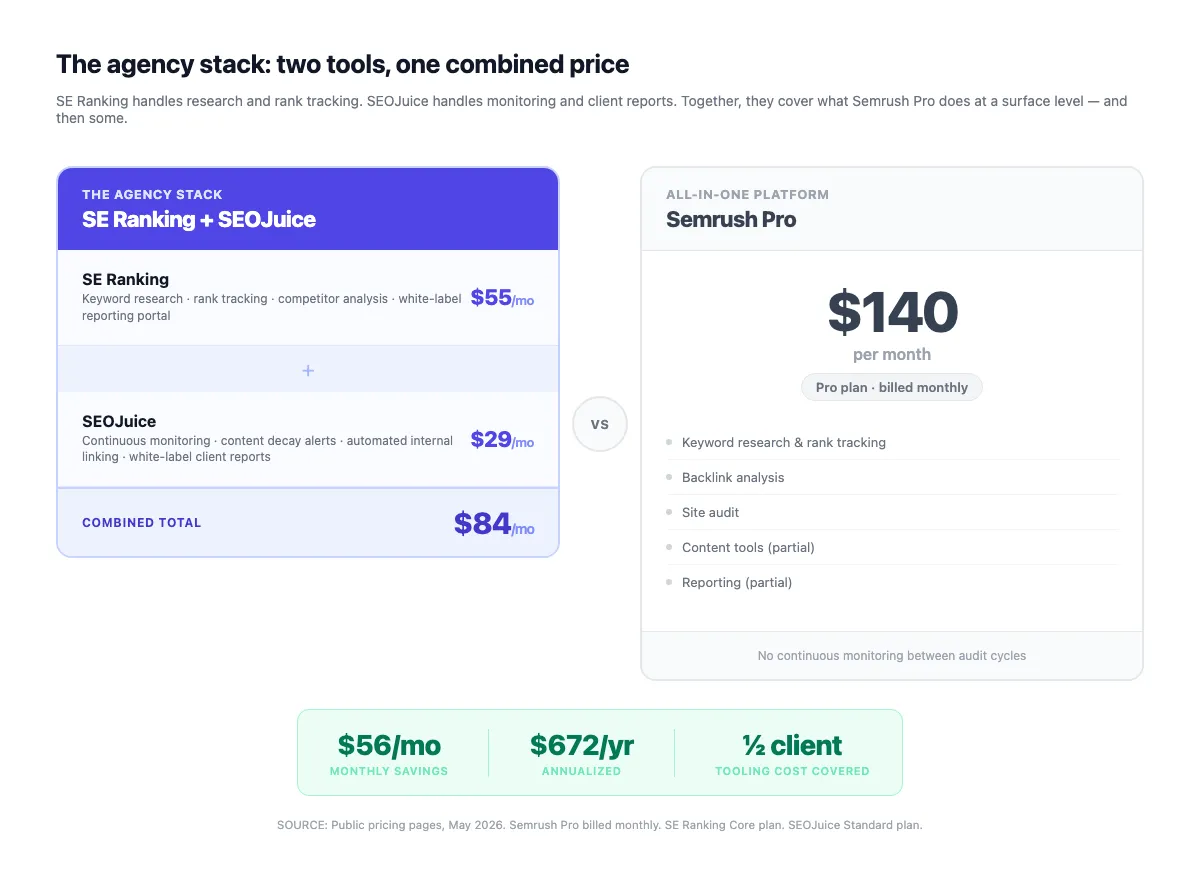
The stack math. SE Ranking Core ($55/mo) + SEOJuice Standard ($29/mo) = $84/month. Semrush Pro is $140/month. The $56/month difference, annualized, is $672. For an agency billing a retainer, that gap covers half the tooling cost for a second client. But the cost argument is secondary to the structural one: the stack covers two different jobs. SE Ranking does research and rank tracking. SEOJuice does ongoing monitoring and proactive alerts. Semrush does both jobs at a surface level, which means it's a compromise in both directions.
(I'm aware I'm the guy who built one of these tools, so take the SEOJuice section with that context. But the stack math is what it is, and SE Ranking's quality is not something I control.)
For budget-first solo marketers: SE Ranking (solo tier)
If you're a solo in-house SEO or freelancer managing one site and you need keyword research plus rank tracking without the agency overhead, SE Ranking's Essential plan is the cleaner recommendation. One tool, one dashboard, manageable pricing.
The white-label reporting features are less relevant here. You're not sending client decks. What matters is keyword database quality and rank tracking accuracy. SE Ranking performs well on both. The UI is less cluttered than Semrush, which is underrated: when you're not managing accounts for clients, you don't want to navigate around features you'll never use.
Ubersuggest at $29/month is worth mentioning as a step down. It works fine for keyword ideation and getting a broad sense of search volumes. I wouldn't rely on it for anything requiring precise keyword data or serious competitive analysis. The database quality issues are well-documented at this point. For someone starting out who wants to learn keyword research before committing to a bigger tool, it's reasonable. For anyone doing this professionally, the $26/month difference between Ubersuggest and SE Ranking is a real quality gap.
For content-first workflows: Surfer SEO, Ubersuggest, Serpstat
Surfer SEO earns a standalone mention because it's notably absent from most Semrush comparison roundups that were written before 2024. It shouldn't be absent from this one.
Surfer is the best-in-class tool for content briefs and SERP-optimized writing. It analyzes top-ranking pages, identifies structural patterns, and generates briefs that tell writers what to cover, how long to go, and which terms to include. Nothing in Semrush's content toolkit does this as well. At $89/month, it's not cheap, but agencies running content programs at scale use it alongside SE Ranking rather than instead of a research tool — the two are complementary, not competitive.
Ubersuggest gets covered here for completeness. It's fine for beginners who want to generate a list of keyword ideas quickly. In 2026, against SE Ranking and Ahrefs, it's not competitive for anything above light ideation work. The AI writing features added in recent versions add noise without improving the core data quality problems.
Serpstat is still in the market. It was a genuine value option in 2022–2023. Testing from late 2025 put Serpstat's non-English keyword volume estimates 30–40% off from both Semrush and Ahrefs on the same seed lists — not random noise, a systematic gap. I haven't seen a rebuttal from Serpstat. Until I do, I wouldn't stake client work on it for markets where volume estimates actually drive decisions.
Mangools: the case for a single-purpose keyword tool
KWFinder is Mangools' standout product and the reason the suite is worth mentioning at all. It's fast, the keyword difficulty scores are sensible, and the SERP analysis view is useful for quickly gauging how competitive a keyword actually is. At $29/month, it's the cheapest entry point for keyword research that still produces reliable data.
Mangools is not for agencies. There's no white-label reporting, limited rank tracking compared to SE Ranking, and the backlink tool (LinkMiner) is shallow. This is a focused tool for solo operators who need a keyword shortlist fast and don't need the surrounding infrastructure. If that's your use case, it's excellent. If you need more, the $26/month gap to SE Ranking buys you a lot more capability.
Should you keep Moz in 2026?
Moz Pro in 2026 is a specialty tool. It's not a Semrush replacement in any meaningful sense — the keyword database has fallen behind SE Ranking and Ahrefs in recent independent comparisons, and the site audit features are functional but not exceptional.
What Moz has that others don't: Domain Authority as a universally recognized reporting metric. Whether you believe DA is a meaningful signal or not (I'm skeptical it predicts rankings as cleanly as it used to), clients and stakeholders recognize the number. Agencies sometimes keep Moz Pro in their stack purely as a reporting token — to have a DA figure that everyone understands on a client deck. At $99/month, that's expensive. If you're using Moz primarily for DA reporting, the free Moz Bar browser extension gets you 99% of the way there for free.
For continuous monitoring and automation: SEOJuice
I built SEOJuice, so I'll be explicit about what I'm claiming and what I'm not. This section covers what problem I was solving — you can decide how much of the rest to weight.
I was running SEO for mindnow (my agency) and vadimkravcenko.com simultaneously. Both used Semrush. The problem wasn't research — keyword data and backlink reports were fine. The problem was that things were slipping between the times I looked. A page that had ranked well for months would start moving down, and I'd notice it three weeks later when the client mentioned their traffic looked off. By then, the issue was obvious in hindsight: a competitor had refreshed their content, the page had gone stale, and the window to act quietly had closed.
Pamela Vaughan at HubSpot documented what catching it early looks like from the other side: after incorporating 2–3 historical post updates per week, HubSpot increased monthly organic views to those updated posts by an average of 106%. The content wasn't bad — it had just stopped being watched. If you have a tool telling you which pages are sliding before the client does, the 106% is the ceiling you're working toward. That's the gap I was trying to close.
Content decay detection. SEOJuice watches pages continuously and assigns a decay score based on traffic trends, ranking movement, and content freshness signals. A page that ranked at position #8 for "project management templates" and starts sliding toward #14 over a 90-day window gets flagged as decaying before the monthly report. The dashboard shows the trajectory: not just the current position, but the trend line that tells you whether this is a temporary fluctuation or a genuine slide. They tell you where you are, not where you're going — that's what I found missing in every research tool I tried.
The practical value for agencies: you have something to bring to the client call before they ask why traffic dropped. That's a different conversation than explaining a drop after the fact.

Automated internal linking. Every time a new page publishes on a monitored site, SEOJuice scans the existing content for contextually relevant internal link opportunities and surfaces them in the dashboard. Manually doing this for a single article takes 30–45 minutes: you open the site search, look for existing pages covering related topics, check which anchor texts make sense, decide which links to add. Multiply that by the number of articles published per month across an agency's client base and it becomes a meaningful time cost. SEOJuice doesn't automate the final decision — it surfaces the suggestions so someone can approve them in two minutes rather than doing the research from scratch.
Automated client reports. White-label reports generated on a schedule you set: weekly or monthly, with client branding. The reports cover site health score, keyword movement, content decay alerts, and technical issues resolved. They go to client email or a branded portal. To be explicit: these are not Semrush-style reports. There are no backlink tables, no keyword rank database exports, no competitive domain comparisons. The reports cover site health and content performance — the things that change between research cycles.

What SEOJuice doesn't do. Keyword research: no. Backlink analysis: no. Competitive intelligence: no. These are deliberate gaps, not oversights. Pair SEOJuice with SE Ranking for those jobs. The combination covers the full agency workflow at $84/month; SEOJuice alone covers the monitoring layer that research tools leave empty.
Pricing. Free plan covers up to 100 pages — useful for testing on a real site before committing. Standard plan is $29/month. Pro is $79/month. Pricing scales by page count rather than by number of users, which matters for agencies: you're not paying per seat, you're paying for the scope of what you're monitoring.
When you should stay on Semrush
Three genuine reasons to not switch, stated plainly.
First: you're a heavy user of Semrush-specific features that have no equivalent elsewhere. Advertising Research (competitor ad copy and budget estimates), Market Explorer (addressable market sizing), and Traffic Analytics (estimated site traffic for any domain) are Semrush capabilities that nothing on this list replicates. If you use these regularly, the switching cost is real and the alternatives don't cover the gap.
Second: your workflow depends on the Semrush API. Custom dashboards, Google Sheets pulls, automated reporting pipelines built on Semrush data — switching means rebuilding integrations. If that infrastructure exists, the true cost of switching is the development time, not just the subscription difference. That math often favors staying.
Third: you're on an annual plan with eight or more months left. Don't disrupt a working setup mid-contract. Use the remaining time to run the audit above, test the alternative stack in parallel, and migrate at renewal. Switching tools under cost pressure tends to produce worse outcomes than switching deliberately.
Frequently Asked Questions
What's the best free Semrush alternative?
Google Search Console combined with Google Keyword Planner covers the majority of what most solo site owners actually need from Semrush. GSC gives you real performance data on your own site (clicks, impressions, position by query) and it's more accurate than any third-party estimate. Keyword Planner gives you search volume data. For site auditing, the free tier of Screaming Frog (up to 500 URLs) handles basic technical crawls. This stack is free and underused. SEOJuice also offers a free plan covering up to 100 pages, which is enough to test the monitoring layer on a real site.
What SEO tools do agencies actually use?
Most run a stack rather than a single platform. The typical pattern is one research tool (SE Ranking or Ahrefs), Google Search Console as the ground truth for performance data, a reporting layer (AgencyAnalytics, SE Ranking's white-label, or SEOJuice), and something for content briefs if they're running a content program (Surfer SEO). According to Search Engine Journal's State of SEO 2024 Agency Report — surveying 1,758 agency respondents — budget constraints are the top barrier to success, which is why the tool-stacking approach has gained traction: covering the same jobs at a fraction of the cost of an all-in-one platform.
Is SE Ranking really as good as Semrush for keyword research?
For most agency workflows, yes. The database gap has narrowed substantially in 2025 and 2026. SE Ranking will miss some long-tail keywords that Semrush catches, particularly at low search volumes. The area where SE Ranking still falls behind is keyword intent classification. Semrush's intent tagging (informational, commercial, transactional, navigational) is more reliable and consistent. If keyword intent mapping is a core part of your research process, that gap matters. If you're primarily doing volume research and competitive keyword analysis, the practical difference is small.
Can I switch from Semrush without losing historical data?
Rank tracking history doesn't transfer between tools — each tool builds its own dataset from the day you start tracking. You'll lose that historical baseline. The workaround is to export your Semrush rank tracking data to a spreadsheet before canceling, so you have a snapshot of where keywords stood. Google Search Console preserves 16 months of performance data natively, and it's the most accurate source anyway. For backlink data, most tools index overlapping sources, so you won't lose information so much as you'll have a different database with different coverage gaps.
What's the best Semrush alternative for agencies?
SE Ranking + SEOJuice at $84/month. SE Ranking handles keyword research, competitive analysis, and rank tracking. SEOJuice handles continuous site monitoring, content decay detection, and automated white-label client reports. One gap worth naming: if a client asks you to pull estimated traffic for a competitor's domain, neither tool does that — you'd need Semrush or Ahrefs for that specific query. For most agency work, that gap doesn't come up often enough to justify $140/month.
Related reading:
- The ultimate SEO toolset for agencies
- Content silos for SEO: how to build topical authority
- How much does SEO actually cost?
- The SEO reports guide
If you want to see how your site stacks up before committing to any tool, run a free SEO audit — it covers technical health, content issues, and internal linking gaps.
Read More
- Why Manual SEO Is Quietly Bleeding Your Agency Margin
- 15 Time-Saving SEO Tips for Freelancers
- 10 On-Site SEO Elements That Influence Rankings in 2026 (Priority Order)
- Internal Linking Statistics 2026: 35+ Data Points (Without the Magic Link Count)
- SEO Statistics 2026: What We Learned Crawling the Web
no credit card required