The Ultimate SEO Toolset for Agencies: A Four-Tier Stack, Not a Logo Roundup

TL;DR: The ultimate SEO toolset for agencies is not Ahrefs versus Semrush with ChatGPT taped on top. The agencies that win in 2026 separate commodity tools from client-facing systems, AI-assisted workflows, and the internal scripts nobody else can buy.
What the current top results get right and miss
Rank 1: OneLittleWeb and the vendor roundup
The first kind of result answers the query like a procurement checklist. It compares all-in-one platforms, backlink tools, rank trackers, audit tools, and free options. That helps if you need a shortlist fast.
The miss is bigger. Agencies are not really asking “which tool is best?” They are asking which work should be standardized, which work should be automated, and which work should remain proprietary. A list of 15 tools cannot answer that, because the same subscription can be sensible for a three-person local SEO shop and wasteful for a technical SEO team with analysts and engineers.
Rank 2: Rankability and the personal stack
The second kind of result is more useful because it shows sequence. “My stack” implies habit. It tells you what someone opens first, what gets ignored, and where the handoffs happen.
Still, one stack does not solve the agency operating model. A content-led B2B agency, a technical SEO agency, and a performance agency should not buy the same set of SEO tools for agencies. The better frame is tiered. The lower tiers serve every client. The upper tiers belong only where the economics justify custom work.
Rank 3: Reddit and buyer distrust
The Reddit result is the most honest one. Buyers are suspicious of dashboards, vague audits, and “AI-powered” promises. Fair.
Clients rarely see the agency’s internal stack. That is the point. The toolset should show up as faster audits, cleaner priorities, fewer manual reports, better QA, and work that compounds across the retainer.
The toolset is not the moat anymore. The operating system is.
I made the mistake the normal way. At mindnow, and later while working on vadimkravcenko.com and seojuice.com, the stack kept getting bigger because every new client exposed a new reporting gap. That felt like maturity. It was usually sprawl — dressed up as maturity.
The first stack feels powerful. Then the dashboards multiply. Then nobody knows which tool owns the truth. Search Console says one thing, the crawler says another, the rank tracker adds a third version, and the report turns into archaeology.
Mike King said the quiet part loudly in a Search Engine Land interview with Danny Goodwin:
At the very least, we're 10 years behind, right? And that's not again being hyperbolic. It's this idea that Google moved beyond the lexical model of search 10 years ago and all of our tools are still just counting the presence and distribution rates of words.
That quote matters because it breaks the shopping-list frame. Screaming Frog, Google Search Console, Semrush, Ahrefs, Sitebulb, Lumar, Sistrix, and rank trackers are not bad tools. The problem is that every competing agency can buy the same basics by lunch.
AI does not rescue the pitch either. The 2024 SEOFOMO State of SEO Consulting Survey found that 81% of SEO consultants and agencies had already added AI tools to daily work. “We use AI” is now a floor — not a differentiator.
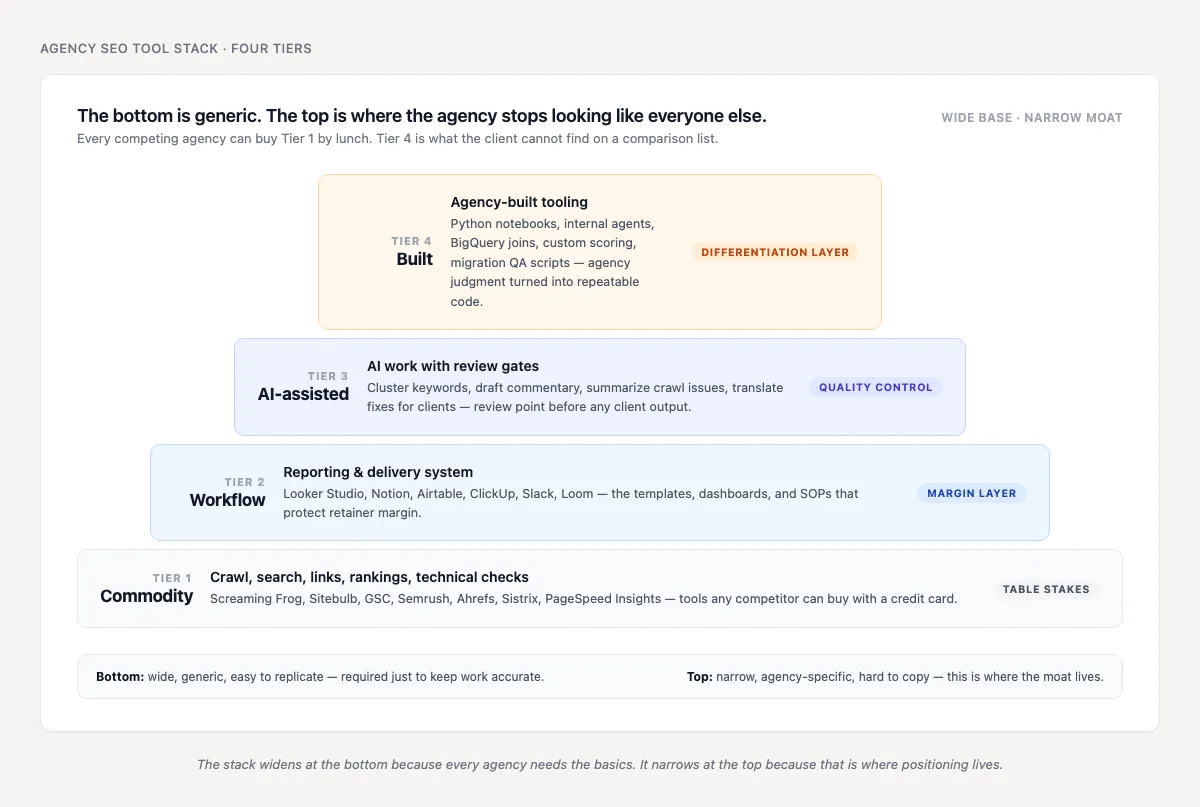
The agency stack has four tiers:
- Tier 1: commodity SEO data.
- Tier 2: reporting and workflow automation.
- Tier 3: AI-assisted execution with review gates.
- Tier 4: agency-built tooling, scripts, notebooks, internal agents, and scoring models.
The bottom keeps work accurate. The top makes the agency harder to copy.
Tier 1 is the commodity layer: crawl, search data, links, rankings, and technical checks
What belongs in Tier 1
Tier 1 is the basic evidence layer. It includes crawling, index checks, Google Search Console extraction, keyword data, link data, SERP sampling, log files, schema testing, speed diagnostics, and rank tracking.
This is where common tools belong: Screaming Frog, Sitebulb, Lumar, Google Search Console, Semrush, Ahrefs, Sistrix, PageSpeed Insights, Chrome DevTools, schema validators, Looker Studio connectors, and rank trackers. Pick examples by job, not by fan club.
A technical SEO team may need log-file analysis and crawl comparisons. A small local agency may need a lightweight crawler, GSC, a rank tracker, and a clean dashboard. Both are valid. The mistake is pretending the tool itself is the positioning.
The commodity test
A tool belongs in Tier 1 if a new hire can learn it in a week, a competitor can buy it with a credit card, and the client would not pay extra because your agency uses it.
The SEOFOMO survey makes this visible. Screaming Frog, Semrush, Google Search Console, and Ahrefs accounted for roughly 69% of top tooling mentions when their reported percentages are added together. That is not an insult. It is proof that these products are table stakes.

Tier 1 tools are allowed to be boring. Boring is good when the task is crawl evidence, link sampling, page-speed diagnosis, or rank monitoring. Boring means the junior analyst can repeat the job next month and get comparable evidence.
How to buy Tier 1 without building a monster
Pick one primary source per job. One crawler. One link database. One rank tracker. One reporting warehouse. Redundant tools need a stated blind spot.
Maybe your link database misses a market you serve. Maybe your crawler struggles with JavaScript rendering. Maybe your enterprise client requires a second data source for migration QA. Fine. Buy the second tool for that reason, not because pride has a terrible renewal rate.
Tier 2 is where agencies quietly recover margin: reporting, templates, QA, and workflows
Most agencies do not lose money because the audit was hard. They lose money because the same audit, report, brief, dashboard, and follow-up email gets rebuilt by hand for every client.
Tier 2 is the delivery system. It includes client dashboards, recurring reports, task templates, SOPs, QA checklists, ticket creation, status-change alerts, and shared documentation. The names are familiar: Looker Studio, BigQuery, Sheets, Airtable, Notion, ClickUp, Asana, Jira, Zapier, Make, Slack, Loom, and internal docs.
The agency rule is simple. If the task repeats three times, template it. If the template gets edited the same way three times, automate the edit. If the automation creates risk, add a review step before it reaches the client.
| Repeated agency task | Bad tool use | Better Tier 2 system |
|---|---|---|
| Monthly SEO report | Manually copy screenshots | Pull data into one dashboard |
| Technical audit | Export 12 files and write from scratch | Standard issue taxonomy plus severity rules |
| Content brief | Start with a blank doc | Brief template fed by SERP, GSC, and internal links |
| Client follow-up | Rebuild the same email | Status-based email draft with human approval |
None of this is glamorous work — it is process debt wearing a nice shirt, and it is usually where margin leaks first.
Tier 3 is AI-assisted work, but only with review gates

The reader often expects this section to be a list of the best AI SEO tools. That frame is too small.
AI is a risk multiplier. A good workflow gets faster. A vague workflow becomes polished nonsense faster — with a confident tone and no shame.
Aleyda Solis has the better operating rule. In her 2024 Majestic SEO interview, she put it plainly:
"Start leveraging AI for the day-to-day SEO tasks within your workflow in a smart way – in a way where you take care of the quality, but you use it to accelerate the tasks that you need to do."
Aleyda Solis, Founder of Orainti, in Majestic's "SEO in 2024" interview series
That second half matters. The agency that adds AI without QA does not become advanced. It becomes faster at making mistakes (I was wrong about this for years).
What AI should do inside an agency stack
AI is useful when the task has clear inputs, a known output shape, and a human review point. It can cluster messy keyword exports, summarize crawl issues, draft report commentary, compare SERP patterns, create first-pass content briefs, generate regex, translate technical issues into client language, and turn meeting notes into tasks.
It can also help analysts move from blank page to structured draft. That matters. The blank page is expensive.
What AI should not own
AI should not own final recommendations, final technical diagnosis, final content strategy, legal or YMYL claims, migration decisions, or client promises.
I thought the danger was bad prose. The bigger danger is confident prioritization without context. A model can make a low-impact title rewrite sound more urgent than a canonical bug if the prompt rewards clean language over business judgment.
The AI evaluation checklist
- What exact task does the AI step replace?
- How many minutes does it save per run?
- What failure mode would hurt the client?
- Who reviews the output?
- Where is the source data stored?
- Can the same result be repeated next month?
- Does the workflow improve the deliverable, or only make it cheaper?
The 81% AI adoption number from SEOFOMO changes the standard. Adoption no longer separates agencies. Quality control does.
Tier 4 is the agency-built layer: scripts, notebooks, internal agents, and proprietary scoring

Tier 4 is where most tool guides go quiet. It is also where serious agencies start to look different.
Mike King put the frustration this way:
I think that we need to frankly grow up and come to terms with this environment that we're in and we need to be building open-source software to support this because the SEO software industrial complex is not giving us what we need to do the job as it is today or how it's going to be in a couple months from now.
The point is not “stop buying tools.” The point is that bought tools cannot contain your entire method.
What Tier 4 can look like
Tier 4 might be a BigQuery workflow that joins GSC, crawl data, links, and conversions. It might be a Python notebook that detects internal-link gaps by template type. It might be a content decay model that flags pages losing clicks before rankings fall.
It can be a migration QA script that compares old and new canonicals. It can be an internal agent that turns crawl exports into draft Jira tickets. It can be a client-specific opportunity score that weighs revenue, difficulty, and implementation speed.
The magic is not the code. The magic is agency judgment turned into repeatable code — and reviewed by people who understand the client.
When not to build
Small agencies should not cosplay as software companies. Do not build when the process is unstable, the client tenure is short, the data is dirty, the owner will leave, or a commodity tool already solves 90% of the problem.
Apps Script that saves three hours every month is wonderful. A half-built internal platform that only one senior person understands is a liability (usually one Monday a quarter).
The build-versus-buy rule
Buy the data layer. Automate the handoff layer. Use AI where review is cheap. Build only where your agency’s judgment becomes repeatable code.
That is the line. If the system only recreates a commodity dashboard, buy it. If it encodes how your agency prioritizes technical fixes, internal links, migrations, or content refreshes, building may make sense.
The agency stack by client type

The stack cannot be designed for fantasy clients. SparkToro and Aira’s 2025 State of Digital Agencies report found that 53% of agency leaders saw AI as a significant threat to the agency business model, 31% retained clients for 36+ months, and 41% described agency health as struggling.
That context matters. Short-tenure and low-retainer clients cannot fund bespoke Tier 4 work. Long-tenure clients can, but only if the work creates compounding value.
Small local client
Tier 1 and Tier 2 should do most of the work. Keep tools simple. Reporting must be cheap to run. AI can draft explanations, but recommendations stay human. A local client usually needs clean GSC monitoring, local landing-page checks, rankings, reviews of technical basics, and a dashboard they can understand.
Content-led B2B client
Tier 1, Tier 2, and Tier 3 matter. The stack needs GSC analysis, SERP review, content briefs, internal linking, refresh workflows, and editorial QA. AI can help create first drafts of briefs and report notes, but an editor or strategist owns the final plan.
Enterprise or technical SEO client
All four tiers can be justified. This is where log files, crawl comparisons, BigQuery, custom scoring, migration checks, and engineering tickets create margin and trust. The client is not paying for another export. They are paying for fewer expensive mistakes.
The recommended agency SEO toolset for 2026
Here is the direct buying answer. Pick one primary tool per category unless you have a known reason to add another.
Crawl and technical SEO
Use Screaming Frog, Sitebulb, Lumar, PageSpeed Insights, Chrome DevTools, and schema validators for crawl evidence, rendering checks, page-speed diagnosis, structured data validation, and technical QA. Do not buy three crawlers because each one has a nicer screenshot. Buy a second when it catches a real blind spot.
Search performance and keyword data
Google Search Console is the source of truth for your site’s search performance. BigQuery exports help when the account is large or the analysis repeats. Semrush, Ahrefs, Sistrix, AlsoAsked, Google Trends, and similar tools support keyword discovery, competitor review, and SERP pattern checks.
Link and authority analysis
Ahrefs, Majestic, Semrush, Search Console link exports, and internal link crawls all have a place. Treat external link data as directional. Treat internal link data as operational. One tells you what the web may be doing. The other tells you what you can fix this week.
Reporting and dashboards
Looker Studio, BigQuery, Sheets, Supermetrics or other connectors, and agency templates belong here. The goal is not a prettier PDF. The goal is one recurring view of performance, work shipped, open blockers, and next actions.
Workflow and delivery
Notion, ClickUp, Asana, Jira, Airtable, Slack, and Loom are delivery tools. They become SEO tools when your agency encodes SEO work inside them: issue taxonomies, brief templates, QA checklists, migration tickets, and status rules.
AI-assisted workflow
ChatGPT, Claude, Gemini, Perplexity, transcript summarizers, code helpers, internal prompt libraries, and retrieval systems belong in Tier 3. The tool matters less than the review gate. A prompt library without source control, examples, owners, and QA is just folklore.
Proprietary layer
Python, SQL, BigQuery, Apps Script, lightweight internal tools, custom crawlers, internal-link models, and client-specific scoring belong in Tier 4. These are the systems your competitor cannot buy with a coupon code.
How to audit your current stack in one afternoon
Open a sheet. List every paid tool, owner, monthly cost, renewal date, core task, duplicate task, and client-facing output. Then tag each tool by tier.
This gets uncomfortable fast. Good. Tool sprawl survives because nobody writes it down in one place.
The five questions
- Would a client pay more because we use this?
- Does this tool reduce delivery time every month?
- Does it create a better recommendation, or just a prettier export?
- Does another tool already do 80% of this job?
- If we removed it today, which client deliverable would break?
Keep boring tools that run critical work. Cut exciting tools that create no repeatable output. Fund the systems that make the agency’s judgment faster.
The hardest cut is usually emotional. A tool can feel strategic because a senior person likes it. That is not enough. The standard is repeatable client output, not internal nostalgia.
FAQ
What are the best SEO tools for agencies?
The best SEO tools for agencies depend on client type, but most stacks need a crawler, Google Search Console, a keyword or competitive research tool, a link database, a reporting system, a workflow system, and an AI assistant with review gates. The differentiator is how those tools connect.
Should agencies choose Ahrefs or Semrush?
Choose based on the job. If your work depends heavily on backlink analysis, test link coverage in your market. If your work depends on keyword research, competitive views, and paid-search overlap, test that workflow. Neither choice creates an agency moat by itself.
Do small agencies need proprietary tools?
Usually not at first. Small agencies should standardize Tier 1 and Tier 2 before building anything. A simple dashboard, repeatable audit template, and clean QA checklist often beat a custom tool nobody maintains.
Can AI replace an SEO analyst?
AI can replace pieces of analyst busywork. It should not replace final judgment, diagnosis, prioritization, or client commitments. The safest AI workflows have narrow tasks, source data, and human approval (and only if the reviewer knows SEO).
How many SEO tools should an agency have?
As few as possible while still protecting quality. A healthy stack has one primary tool per job, documented handoffs, and a clear reason for every duplicate. If nobody can name the deliverable a tool supports, cancel it.
Final position: stop buying a bigger stack and start designing a sharper one
The best SEO tools for agencies are not the same for every agency. The right stack has a boring bottom and a distinctive top. Commodity tools keep the work accurate. Reporting systems protect margin. AI speeds the middle, if humans review it. Proprietary workflows turn agency judgment into an asset competitors cannot buy.
The stack I would build now for seojuice.com is smaller than the one I would have built years ago. Fewer dashboards, more repeatable systems, more work encoded into the process instead of trapped in one senior person’s head — that is the direction I would choose.
Want a sharper SEO operating system?
If your agency is still stitching audits, briefs, reports, and internal-link recommendations together by hand, start with the repeatable parts. SEOJuice helps turn internal linking and page-level SEO work into a system your team can run consistently, without pretending another dashboard is a strategy.
Read More
- Why Manual SEO Is Quietly Bleeding Your Agency Margin
- 15 Time-Saving SEO Tips for Freelancers
- 10 On-Site SEO Elements That Influence Rankings in 2026 (Priority Order)
- Internal Linking Statistics 2026: 35+ Data Points (Without the Magic Link Count)
- SEO Statistics 2026: What We Learned Crawling the Web
no credit card required