Answer Engine Optimization (AEO): The Practitioner's Guide for 2026

TL;DR: Answer engine optimization is not the next big thing. It is the old SEO promise with a harsher scoreboard: can ChatGPT, Google AI Mode, Perplexity, and Claude name you, cite you, and send qualified visitors when a buyer asks for an answer?
I have watched the same pattern from three angles: client builds at mindnow, my own traffic on vadimkravcenko.com, and product-led SEO at seojuice.com. The mistake was treating AEO as a new channel instead of a measurement problem. We already had content. We did not know whether AI systems trusted it enough to repeat it.
The current SERP does part of the job. Reddit gives the street-level version: make content understandable, trusted, and surfaced by AI-powered answer engines. Forbes frames AEO as brand visibility, which is closer to the business problem. Coursera gives the beginner definition: optimize for question-shaped queries. All three miss the operator problem. They blur mentions, citations, links, clicks, and revenue into one vague idea called “visibility.”
AEO is older than ChatGPT, and that matters
AEO did not begin when ChatGPT became popular. Jason Barnard, CEO and founder of Kalicube, traces the term back years before the current AI search rush.

“In 2017, I coined the term Answer Engine Optimization.”
That origin matters because AEO was a push against the ten-blue-links mindset. The old promise was simple: rank for queries. The newer scoreboard is harsher — get named in answers, cited as a source, and trusted enough to survive synthesis.
Featured snippets, knowledge panels, voice search, and People Also Ask were already moving search in this direction. LLMs made the shift obvious. They put the answer in front of the user and force brands to ask an uncomfortable question: if the system summarizes the market, do we appear?
How AEO depends on SEO
At mindnow, the client work that later looked like AEO was rarely magical. It was boring clarity: service pages that answered the buying question, source pages that backed the claim, and internal links that made topical relationships obvious. seojuice.com exists because that last part is where most sites quietly leak authority.
AEO and SEO sit on the same infrastructure. Crawlability still matters. Page quality still matters. Links still matter. The difference is the visible outcome. In classic SEO, you fought for a ranked page. In answer engine optimization, you fight for selection inside a generated answer.
What answer engine optimization actually means
Answer engine optimization is the practice of making your brand and content easy for answer engines to understand, trust, retrieve, cite, and recommend when users ask questions.
Understand means the page has clear entities, definitions, and relationships. If your product category, audience, use case, and proof are buried under brand copy, extraction gets harder.
Trust means claims are backed by sources, author signals, brand consistency, and external corroboration. A page saying “we are the leading platform” gives an answer engine very little to work with. A page showing who you help, what evidence supports the claim, and where the data comes from gives it more.
Retrieve means the content can be found in the corpus or index the answer engine draws from. Some systems use live web search. Some use search APIs. Some answer from model memory. Some mix all three.
Cite means the system can point to a specific URL or source. Recommend means the brand appears as a viable option when the user asks what to buy, compare, or try.
“success should be measured by brand citations in sources or brand mentions and links within the LLM answers”
Aleyda Solis gets the measurement frame right. Not every AI answer includes links. That is why AEO reporting has to separate citations, mentions, recommendations, and actual visits.
AEO optimizes for selection
A ranking report asks, “Where did my page land?” AEO asks, “Did the system select my brand or source when it had other options?” Those are different questions, and the second one is closer to how buyers now research vendors (ChatGPT, Perplexity, Claude, Gemini, Google AI Mode).
Question keywords are only the entry point. “What is answer engine optimization?” matters, but the money often sits in prompts like “best internal linking tool for a SaaS blog,” “SEO tool alternatives for a small team,” or “how to fix orphan pages at scale.”
Citations, mentions, and recommendations
A citation points to a URL. A mention names your brand. A recommendation puts your brand into the consideration set. A click sends the user to you. A conversion proves business value.
If you collapse those into one metric, you will lie to yourself. A brand mention with no link can still shape demand. A citation can send no traffic. A click can be low intent. The reporting has to keep the chain visible.
AEO vs SEO vs GEO vs AISO
The acronym pile is exhausting, and some of it is vendors trying to rename work you already do. Still, the terms can be useful if you treat them as a map rather than a turf war.

| Term | Primary surface | What you optimize | What you measure | Best use case |
|---|---|---|---|---|
| SEO | Google and Bing organic results | Pages, technical access, links, content quality | Rankings, clicks, conversions | Durable search demand |
| AEO | Answer engines and AI answers | Answer-ready sources and brand trust | Citations, mentions, links, clicks | Direct answers and recommendations |
| GEO | Generative engines | Content presentation inside generated responses | Inclusion and visibility in generated answers | Researching AI response influence |
| AISO | Broad AI search surfaces | Mixed AI search visibility | Cross-platform reporting | Umbrella planning |
AEO is the buyer-facing frame. GEO is the research and systems frame. SEO is still the infrastructure. If your pages cannot be crawled, understood, and trusted, the acronym on the dashboard will not save you.
When AEO is the better term
Use AEO when the user’s task is answer-shaped: define, compare, choose, troubleshoot, shortlist. That is where being named changes the buying path.
Use SEO when you are talking about indexation, rankings, internal links, page updates, and conversion from organic search. Use GEO when you are discussing generated-response behavior across models. The work overlaps. The measurement lens changes.
How answer engines decide what to cite
No one outside the model teams can see every retrieval rule, model weight, or citation policy. Anyone pretending otherwise is selling certainty they do not have. A useful mental model is still possible.

- The user asks a question.
- The system interprets intent and entities.
- It retrieves candidate sources or draws from trained knowledge.
- It compares possible answers.
- It writes a response.
- It may cite sources, name brands, or both.
Retrieval and ranking are different steps
LLMs do not rank pages the way Google’s classic results page ranks them. Some answer engines use live web retrieval. Some rely on search partners. Some answer from model memory. Some blend sources, then cite only a subset.
That matters for content. A page that buries the answer below five paragraphs of positioning copy is harder to extract. A page with unsupported claims is easier to ignore. A site with weak internal structure makes topical relationships harder to confirm.
Brand consensus beats isolated claims
Answer engines look for corroboration — not in a human courtroom sense, but in the practical sense of repeated, consistent evidence. If your site says one thing, review sites say another, and comparison pages say nothing at all, the system has little reason to prefer your version.
Internal links help here. They do not force an AI answer to cite you. They help crawlers and retrieval systems understand which pages support which topics. A definition page, comparison page, methodology page, and source hub should reinforce each other instead of floating as disconnected URLs.
The AEO checklist is where teams go to die
The checklist is seductive. It feels safe.
“SEO is a checklist culture.”
Mike King wrote that in Chapter 16 of iPullRank’s The AI Search Manual, and AEO is already repeating the pattern. Schema. FAQs. Author bios. Short paragraphs. Citations. Entity pages. Reddit mentions. “Best X tools” pages. All can help. None works as an isolated hack.
What actually compounds
FAQ blocks help only when the underlying answer is useful. Schema labels content; it does not create trust. Author bios support authority, but they cannot rescue thin claims. Reddit threads matter when real users discuss you, not when someone seeds a fake conversation and hopes a model sees it.
The better starting question is blunt: where would being cited change a buying decision?
Start there. Pick the questions tied to revenue. Then build assets that deserve to be retrieved, cited, and recommended.
What to do instead: build answer assets
Answer assets are pages or page sections built to be extracted, trusted, and cited. They are not blog posts wearing an AI-search costume. They answer a real question, name the entities clearly, support the claims, and connect to the rest of the site.
Definition assets
A definition asset should answer the term in the first 80 to 120 words. Then it should explain what the term includes, what people confuse it with, and how it applies in practice.
Weak version: “Our platform helps teams transform organic growth.” Stronger version: “Internal linking software finds orphan pages, recommends contextual links, and helps search engines understand which pages support each topic cluster.” The second version gives an answer engine something to extract.
Comparison assets
Comparison pages work when they help a buyer choose. “Tool A vs Tool B” content that only flatters your product is just sales copy. A useful comparison explains fit, trade-offs, pricing shape, setup effort, and cases where the competitor may be better.
This is where founders often get nervous. They want the page to win every scenario. Buyers do not believe that. Models probably should not either.
Evidence assets
Evidence assets include original data, research summaries, benchmarks, customer patterns, and source hubs. They give answer engines a reason to prefer your page over a generic explainer.
On vadimkravcenko.com, the pages that earn durable visibility are rarely the clever ones. They answer the exact question and connect to a larger body of related work. I keep relearning this (I was wrong about this for years). Clever framing gets attention for a week. Clear source material compounds.
Methodology and support pages
Methodology pages explain how your product, process, or scoring system works. Use-case pages tie that method to a specific audience. Glossary pages define the surrounding terms. Internal links connect the cluster.
For seojuice.com, that means a page about orphan pages should connect to internal linking, crawl depth, topic clusters, and link equity. The product page should not be the only page trying to explain the category.
- Put the direct answer near the top.
- Name the entities clearly.
- Support specific claims with sources.
- Use crawlable URLs.
- Add internal links from related pages.
- Show external proof where possible.
- Give the model a reason to prefer your page over a generic article.
How to measure AEO without lying to yourself
AEO reporting is messier than SEO reporting. That does not make it unknowable. It means you need separate measures for separate outcomes.
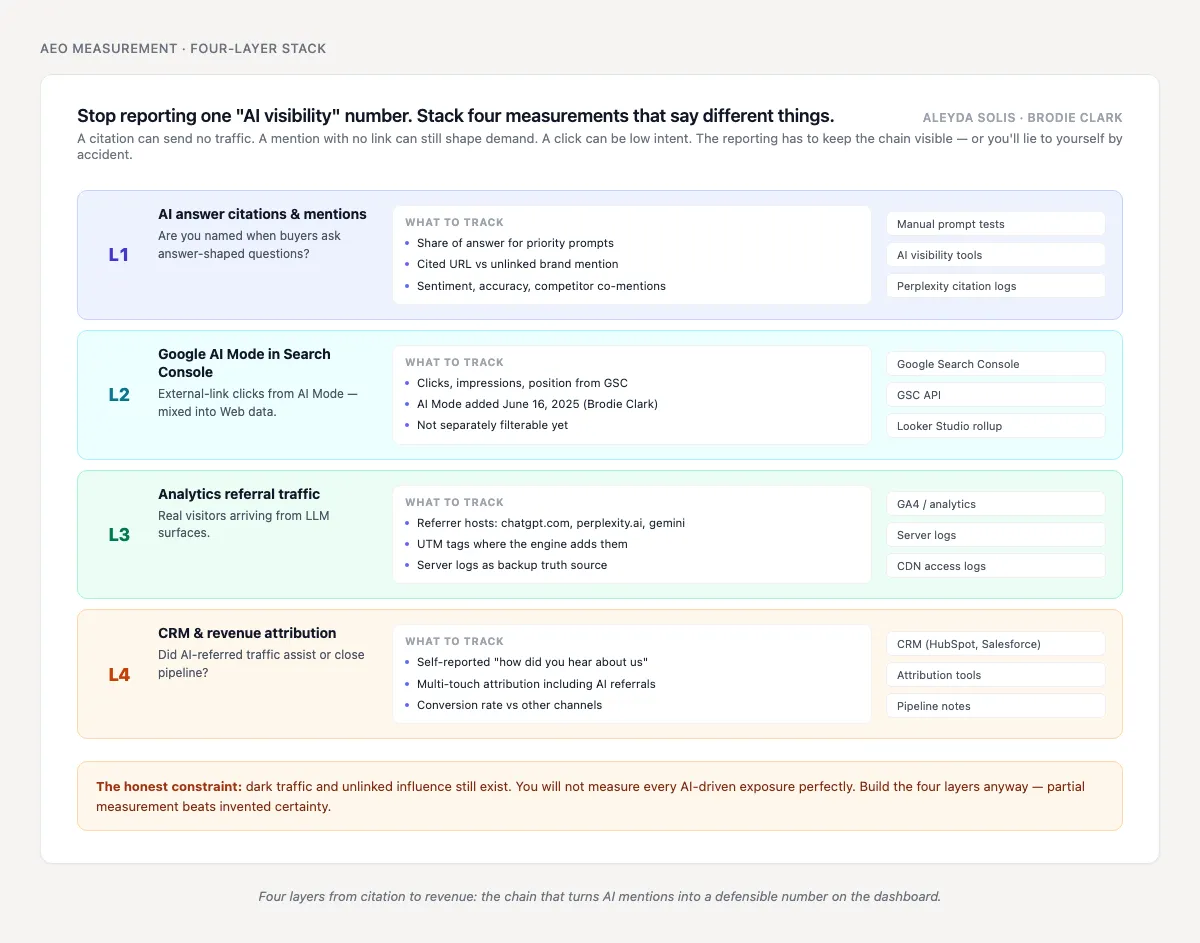
| Metric | Tool or source | What it tells you | What it cannot tell you |
|---|---|---|---|
| Brand mentions | Manual prompt tests, AI visibility tools | Whether your brand appears in answers | Whether the user clicked or bought |
| Source citations | Perplexity, ChatGPT citations, Google AI answers | Which URLs are used as sources | Whether the citation was persuasive |
| Referral traffic | Analytics and server logs | Visits from LLM surfaces | Unlinked influence and dark traffic |
| Google AI Mode clicks | Google Search Console | External-link clicks from AI Mode | Separate AI Mode filtering |
| Pipeline impact | CRM and attribution notes | Whether AI referrals assist revenue | Every pre-click exposure |
What Google Search Console can show
Google added AI Mode tracking to Search Console on June 16, 2025. Clicking an external link in AI Mode counts as a click. Impressions and position follow standard rules.
The catch: AI Mode data is mixed into Web data and is not separately filterable. Brodie Clark verified this with a 20,000-plus impression experiment, showing that AI Mode data outside Labs is grouped with Web data in the Performance report.
Build a prompt set before a dashboard
For ChatGPT, Perplexity, Claude, and other answer engines, you still need prompt testing, citation tracking, analytics tagging, and CRM follow-through. Start with a small prompt set tied to revenue (in 2026, this is budget work, not curiosity).
Track share of answer for priority prompts. Record sentiment and positioning. Separate “mentioned” from “cited.” Screenshots are useful for diagnosis. They are weak as proof.
Is AEO traffic actually valuable?
AEO traffic is real and qualified, but not a cheat code.

Maximilian Kaiser and Christian Schulze published a Marketing Science study in April 2026 that analyzed 12 months of first-party Google Analytics data from 973 ecommerce websites. The sites represented $20 billion in combined annual revenue, more than 50,000 organic LLM transactions, and 164 million transactions from traditional channels.
“One year after launch, oLLM exhibits a higher CR and RPS than paid social, but lower CR and RPS than all other traditional channels.”
Translated: organic LLM traffic converted better than paid social in that dataset, but worse than most traditional channels. The same paper found stronger outcomes in complex product categories (see Kaiser and Schulze for the channel breakdown).
That matches the practical pattern. Complex products benefit first because buyers ask research-heavy questions before they act. B2B software, consulting, developer tools, security, finance, and healthcare all fit that behavior better than commodity impulse purchases.
The audience is large enough to matter. Pew Research Center’s June 2025 report by Olivia Sidoti and Colleen McClain found that 34% of U.S. adults had used ChatGPT, about double the 2023 share. Adoption reached 58% for adults under 30 and 41% for adults ages 30 to 49. Workplace use among employed adults rose from 8% to 28% in two years.
That is the B2B signal. The audience is young enough to grow, work-related enough to affect buying research, and already big enough that ignoring it looks lazy.
A 30-day AEO plan that does not become theater
Do not start with 500 prompts. You will create a spreadsheet nobody trusts. Start small enough that the team can review the answers by hand.
- Week 1: Pick 20 to 40 prompts tied to revenue. Include category prompts, comparison prompts, problem prompts, and “best tool for X” prompts. Use the language buyers actually use in sales calls, support tickets, and search queries.
- Week 2: Run the prompts across major answer engines. Test ChatGPT, Perplexity, Claude, Gemini, and Google AI Mode. Record whether your brand appears, whether your URLs are cited, which competitors appear, and what claims the answer makes.
- Week 3: Build or repair answer assets. Start with pages that already have search visibility or conversion value. Fix pages closest to winning before creating new ones.
- Week 4: Strengthen the source cluster. Add internal links, cite better sources, clean up vague claims, update author and company information, and make the answer easier to extract.
Repeat monthly. Models update, retrievers change, and citation behavior can shift without warning. I do not yet trust any single platform’s citation pattern as permanent — useful, yes; stable forever, no.
Common AEO mistakes
Chasing every AI platform equally
Your buyers do not use every tool equally. Test broadly at first, then focus on the surfaces that show up in analytics, sales conversations, and customer research.
Measuring only referral traffic
Referral traffic misses unlinked mentions and zero-click influence. A buyer may see your brand in an answer, search your name later, and arrive through branded organic or direct.
Counting a mention and a citation as the same thing
A mention means the brand appeared. A citation means a source was used. A recommendation means the brand was positioned as an option. Keep them separate.
Publishing generic FAQ pages
FAQ pages filled with shallow answers rarely deserve citations. Add FAQs where they clarify a real page. Do not make them the strategy.
Optimizing prompts your buyers would never ask
Vanity prompts feel good because they produce screenshots. Revenue prompts expose gaps. Choose the second category, even when the first one is more flattering.
FAQ
What is answer engine optimization?
Answer engine optimization is the practice of making your brand and content easy for AI answer engines to understand, trust, retrieve, cite, and recommend when users ask questions.
Is AEO different from SEO?
Yes, but it depends on SEO. SEO builds the crawlable, trustworthy content base. AEO focuses on whether answer engines select that content inside synthesized answers.
Is AEO the same as GEO?
They overlap. AEO is the buyer-facing frame around answers, citations, and recommendations. GEO usually describes visibility inside generative engines more broadly.
How do I get cited by ChatGPT?
Create extractable pages with clear answers, specific entities, supported claims, crawlable URLs, and external corroboration. Then test prompts and track whether your URLs appear as sources.
Can I track AEO in Google Search Console?
Partly. Google AI Mode clicks and impressions are included in Search Console Web data, but AI Mode is not separately filterable. You need separate tracking for other answer engines.
Is AEO worth it for small sites?
Yes, if you target specific questions where authority can be earned. Small sites usually win by being clearer, more specific, and better sourced than generic publishers.
Fix the source before the dashboard
The next-big-thing framing misses the point. AEO is the thing SEO was always drifting toward, now with public answers and harsher feedback. If an answer engine cannot understand what your company does, why your page is trustworthy, and which source supports the claim, it has no reason to cite you. Fix that before buying another dashboard.
If your internal links are the weak point, start there. seojuice.com helps teams connect related pages, surface orphan content, and build clearer topic clusters — the kind of source structure answer engines can actually follow.
Discussion (2 comments)
devops_guru
Interesting angle but skeptical — conversational queries and "ask engines" (ChatGPT/Bard) often surface answers based on retrieval stacks, vector similarity and prompt heuristics rather than on-page SEO, so AEO may be chasing model behavior more than user intent. If you're serious, instrument prompt-level analytics, run A/Bs on canonical Q&A snippets, and measure answer‑level CTR and hallucination/error rates before rewriting sitewide. Practically: add concise canonical answers, FAQ/QA schema and a RAG-friendly knowledge layer instead of treating AEO as a drop-in replacement for classic ranking signals.
GrowthHacker23
Totally fair take — tbh AEO can feel like trying to optimize for a ghost if you only look at on‑page SEO. Retrieval + embeddings + prompt plumbing usually call the shots for LLM answers. That said, I’d argue it’s not either/or — you want both a solid RAG layer and canonical on‑page signals.
Stuff I’d do (practical, battle‑tested):
- Instrument prompt‑level analytics: log prompt+context, chosen docs, and model response. Tools: PromptLayer or LangChain callbacks + your normal logging.
- Key metrics to track: answer‑level CTR, follow‑up question rate (users asking clarifying Qs after an answer = weak result), hallucination/error rate (sample + human eval or automated cross‑check with a search API), precision@k for retrieved docs, and MRR for answer ranking.
- A/B test approach: pick top 50 queries, serve (A) current page snippets vs (B) concise canonical answers + RAG retrieval. Randomize by user/session, measure CTR, dwell, follow-ups, and hallucinations.
- Implement schema (FAQPage/QAPage) and a RAG‑friendly knowledge layer anyway — chunk with good metadata (source, date, confidence), store embeddings in Pinecone/Weaviate/Elastic + embeddings API. That gives immediate wins for retrieval and helps models cite correctly.
- Small pilot first: don’t rewrite sitewide. Start with high‑intent FAQs and iterate.
Personal anecdote: ran a pilot on a docs section last year — adding concise canonical answers + metadata + RAG reduced follow‑up clarification rate and improved answer CTR. Organic rankings didn’t collapse either — SEO still mattered for discovery, but the RAG layer made the answers actually useful in conversational contexts.
Curious — have you tried prompt instrumentation already? If so, what signals did you find most predictive of hallucinations?
StartupLife99
tbh a ChatGPT-first SEO play sounds risky — maybe keep classic SEO + short canonical answers and FAQ schema instead
Read More
- Why Manual SEO Is Quietly Bleeding Your Agency Margin
- 15 Time-Saving SEO Tips for Freelancers
- 10 On-Site SEO Elements That Influence Rankings in 2026 (Priority Order)
- Internal Linking Statistics 2026: 35+ Data Points (Without the Magic Link Count)
- SEO Statistics 2026: What We Learned Crawling the Web
no credit card required