Why Backlink Exchanges Look Like Free Authority and Aren't

TL;DR: Backlink exchanges aren't bad because Google penalises them. They're bad because the math is against you whether or not anyone catches you. A reciprocated link from a peer-size site carries, by my estimate, roughly 30-40% of the authority of a comparable non-reciprocal placement, because anchor reciprocity, footprint clustering, and partner-site decay each take a cut. Run the fifteen-minute audit below, then move the hours into the higher-yield archetypes the field has documented for over a decade: original data, expert round-ups, tool integrations, topical-authority series. None carry the discount; none decay with somebody else's CMS.
I traded links three times in 2018 with peers in a niche I was running. Six months later, two of those placements had landed on pages that quietly dropped out of the index. The third had been retitled and reassigned to a different topic, the anchor now sitting under a paragraph about something else. Net build: three swaps. Net kept: zero.
Most articles warning operators off exchanges wave at Google penalties and call it a day. That framing isn't wrong, but it's not load-bearing. Tell a junior SEO "don't swap because of penalties" and they'll reasonably observe that nobody in their network has been penalised, then keep swapping. The math is what's actually against you, and it doesn't depend on Google's enforcement appetite. That's what I want to walk through.
What a "free authority" link actually looks like next to a swap
Strip the terminology away. A non-reciprocal link exists because the citing author chose to write it: somebody needed a resource, your page was the best fit, they linked. An exchange is a different object, two pages linking to each other under a coordinated arrangement, usually with synchronised timing and anchor text the partner asked for. A reciprocal link is the textbook version; most exchanges are reciprocal links in slightly more decorative outfits.
The reason this matters is not that "Google can tell." It's that the value of the placement is a function of how content-driven it looks, and a swap was never content-driven. Google's spam policies have listed "excessive link exchanges" as a violation for years (documented, not my read), but that's the enforcement framing. The structural framing is the one I'm more confident about: a deal-driven link is worth less than a chosen one, whether or not a reviewer ever opens the case.
The three places authority leaks out of a swap
The discount doesn't come from a single Google rule; it comes from three independent leaks that stack. I'm going to be uneven about my confidence here on purpose, because the evidence behind these three is uneven, and pretending otherwise is how SEO advice goes stale.
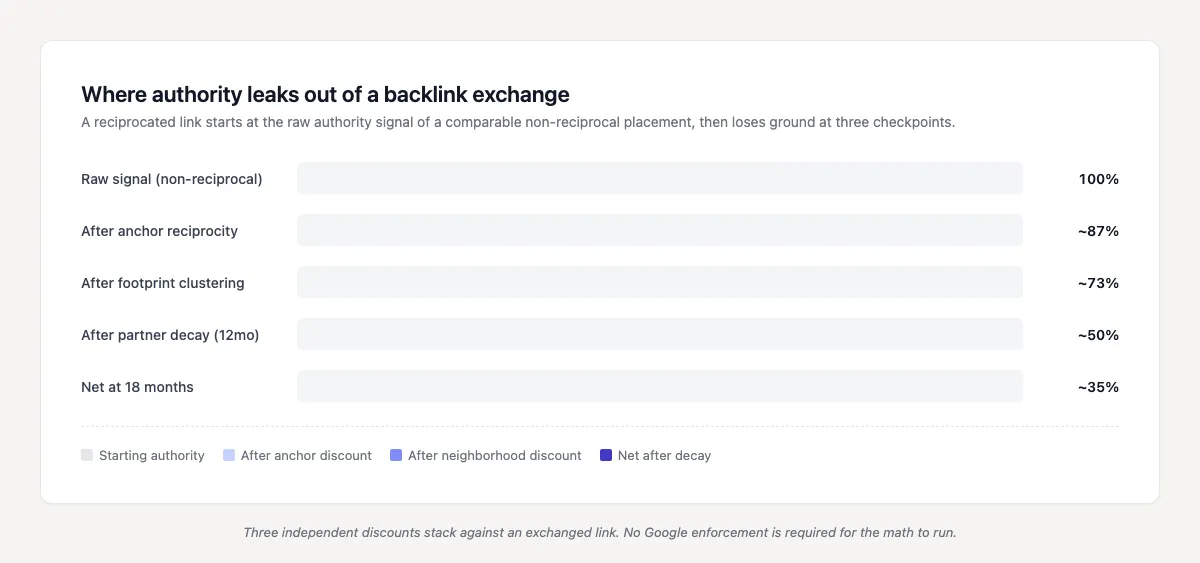
Leak 1: anchor reciprocity. When both sides of an exchange use anchor text the partner asked for, the patterns become observable, and this part isn't a hunch. Bill Slawski's 2013 analysis of Google's link-context patent showed that the algorithm captures roughly five words on each side of every link and checks whether the same context identifiers recur across all pages pointing to the same target, which makes uniform anchor-text matching detectable without any human reviewer. (Slawski passed away in 2022; his archived write-up is at SEO by the Sea, November 2013.) Glenn Gabe found the real-world version a year earlier: reviewing dozens of Penguin-hit sites in 2012, he documented that sites where 80%+ of inbound links used exact-match anchor text "got smoked," while diversified profiles survived. That's the well-established canon, and I'd defend it without hedging; both sides of a swap are, by design, requesting commercial anchors, precisely the pattern Gabe watched Google target. Where I do hedge: the size of the cut. Call it 10-15% of the raw signal, but that's my operator estimate, not a measured figure. (The nofollow/dofollow piece covers why anchor signals matter.)
Leak 2: footprint clustering. Exchange rings (especially three- and four-way trades, but also dense one-to-one networks) cluster in the link graph in ways organic networks don't. Slawski traced this too. In his April 2012 write-up of the "dense bipartite subgraph" patent, he described how Google identifies tight clusters of pages linking to the same target under coordinated patterns, and noted that blog networks started getting "zapped" once the algorithm could tell a coordinated cluster from an organic one. The mechanism is documented; the magnitude is where I lose certainty. I'd put it at another 10-15%, but honestly I can't separate it cleanly from the anchor leak in my own audits, so treat the Leak 1 / Leak 2 split as a convenient fiction.
Leak 3: partner decay. This is the one nobody quantifies, and I think it does most of the damage, though "I think" is doing real work in that sentence. The partner site you swapped with in month 0 will not be the same site in month 18. Pages get pruned, redirected, noindex'd, retitled; the placement is still there somewhere, but the page has degraded, and your link with it. The base rate underneath this is the one number here I'd actually stand on: Ahrefs' 2022 link-rot study found at least 66.5% of links acquired since January 2013 were already dead, climbing to 74.5% once redirected or devalued links are counted. That's the floor for all links, and it's published research, not my read. Swap partners, small operators on the churn-prone end of the web, almost certainly sit below it. At 18 months, I'd guess roughly 30-40% of swapped links sit on lower-quality or noindex'd pages, but I haven't measured that across a large enough sample to call it firmer than a guess.
| Leak | Approximate cost | Mechanism |
|---|---|---|
| Anchor reciprocity | 10-15% (operator estimate) | Patterned anchor text triggers the PageRank discount on coordinated phrasing |
| Footprint clustering | 10-15% (operator estimate) | Tight mutual-link clusters look different from organic citation networks |
| Partner decay | 30-40% by 18mo (my guess) | Pages get pruned, retitled, sold, noindex'd, and the placement degrades with the host |
| Net signal at 18mo | ~30-40% of non-reciprocal | Discounts stack multiplicatively, not additively |
Stack the three: 100% × 0.875 × 0.85 × 0.65 ≈ 48% after a year, and the curve is still falling. (To be transparent, that arithmetic is only as good as its inputs, and I just told you two of the three are estimates.) None of it requires Google to enforce anything: the math runs the same in a world where manual actions don't exist.
The decay curve nobody draws

| Months after swap | Approximate partner-link survival |
|---|---|
| 6 months | ~90% (most placements still healthy) |
| 12 months | ~75% (small sites start pruning) |
| 18 months | ~60-65% |
| 24 months | ~50% |
| Non-reciprocal citations (24mo) | ~88% (for comparison) |
Be clear about what these numbers are. They come from a handful of swap audits across my own portfolios. Small sample, not a study, and I won't dress it up as one. I genuinely don't know the true survival curve for the broader population of swaps; I only know mine, and mine is a biased sample of one operator's niches. But the direction is consistent with the Ahrefs link-rot data: if two-thirds of all acquired links die over nine years, the short-term curve for the low-authority pages that describe most swap partners is almost certainly steeper than for editorial citations. The shape I'm confident about. The percentages are mine, and you should hold them loosely.
The reason it's stair-stepped is structural. The partner site is, on average, a small operator who changes topics, sells the project, or simply prunes. The partner thrilled to swap with you in 2024 may have moved on by 2026, and your placement moves with them. Compare that to a non-reciprocal link earned by content the citing author chose to write: when the topic stays relevant, the citation stays. Link juice, the thing that actually flows from a link, is a function of the citing page's own health, and editorial pages stay healthier longer than swap-placed paragraphs. This is the leak nobody warned me about in 2018: the slow, quiet death of placements I'd spent hours negotiating.
Why the penalty story is the wrong reason to refuse exchanges
I'll concede the obvious point. The Webmaster Guidelines explicitly call out link schemes, and manual actions for reciprocal-link rings are real; I've seen them hit. But the cases were obvious: dense ten-way rings, identical anchor text across dozens of placements, operators who'd run paid networks for years. Manual actions are expensive to issue, issued sparingly, and louder than a single peer-to-peer swap.
The bigger cost is the algorithmic discount that runs against patterned link profiles whether or not a reviewer ever opens the case. Google confirmed in September 2016, through Gary Illyes at Pubcon, that Penguin had been folded into the core ranking system and now runs in real time. That's on the record, not my inference, so the discount on coordinated patterns is continuous, not a periodic sweep. If you've already been hit, the triage playbook is at how to recover from a Google penalty; this piece is for the operator who hasn't been hit and is deciding where the next three hours go.
What to do this week if you've been swapping
For each existing swap placement, check whether the linking page still indexes and whether the anchor reads as natural or coordinated. Fifteen minutes per placement with the Search Console URL Inspection tool plus a quick read; a spreadsheet with three columns (partner URL, current state, anchor text) handles twenty to thirty swaps in under two hours.
For decayed swaps where the page has dropped quality or moved off-topic: skip the disavow file unless you've accumulated thirty or more degraded placements. The algorithmic discount handles most of it, and disavow files are easier to misuse than people think. The penalty recovery playbook covers when disavow earns its keep. For high-value live swaps: leave them alone and let them age out. Then take the hours you'd have spent pitching a new swap and move them into the archetypes below.
The archetypes that beat a swap on a per-hour basis
These archetypes aren't secret. They're the link-building canon documented by people like Paddy Moogan (whose Link Building Book at Aira treats data-led acquisition as a primary tactic), Jon Cooper at Point Blank SEO, and Ross Hudgens at Siege Media. What I'm arguing isn't the tactics; it's the opportunity cost: the two-to-four hours you'd spend negotiating one swap buy a meaningful chunk of any of these instead.

Archetype 1: original data. Run a survey, scrape a public dataset, do a small study. Eight to fifteen hours produces a piece journalists and bloggers cite for years, because data ages slowly when documented well. This is the one I've leaned on hardest. The data pieces I've shipped on seojuice.com (a link-decay analysis, a Core Web Vitals benchmark across thousands of sites) out-earn anything I ever got from swapping, by a wide enough margin that I stopped pitching swaps at all. I won't put a precise multiple on it, because I didn't track the two cohorts side by side and any clean-sounding number now would be invented. Directionally: not close. First inbound link usually within four to eight weeks. Yield: high.
Archetype 2: expert round-up answers. Get on the source lists for journalists writing about your space (Featured, Qwoted, journalist Slack groups). I answer two or three queries a month on Qwoted, and most don't place; don't expect a hit rate above one in four. The ones that land place fast and decay almost never, because news and trade citations don't sit on the churn-prone end of the web. Thirty minutes per pitch. Yield: medium-high.
The longer bets. The other two are slower, so I'll group them. A tool integration is a small, useful thing another tool's userbase already wants: a template, a calculator, an export script. Twenty to forty hours of engineering, and decay is low because the asset keeps existing. A topical-authority series is six to ten articles deep on one narrow topic, wired together with a tight internal-linking structure, where the first inbound link might not arrive for months. I've only run the series fully once (a sample of one, so weight that accordingly); it took the better part of a year to pay off but is the highest-yield thing I've shipped. The ecommerce version: link building for ecommerce.
None carry the reciprocity discount. None decay with somebody else's CMS. Each builds an asset I keep when the relationship ends. The swap, by contrast, always needed new swaps to replace the decayed ones.
When a swap actually does make sense (rare, but the math isn't always against it)
I want to be honest about the exceptions, because I've made the math-is-always-bad argument too firmly before and had someone correctly point out a counterexample I'd waved off. There are conditions under which a swap can be neutral or slightly positive. Rarer than people who pitch swaps admit, but real. Four of them:

Condition 1: contextually-different sites. Serve different audiences but reference similar concepts (a B2B SEO operator and a content-strategy newsletter), and a swap reads more like a cross-citation than a coordinated trade. Condition 2: an existing editorial relationship. If you already write for them or they for you, the placements land on different timelines, anchors, and contexts, so it isn't structurally a swap to a graph classifier. Condition 3: time-asymmetric placements. Linking now for a link back nine to twelve months later means different timestamps and less coordination evidence. Condition 4: tier mismatch. A small site swapping with a much larger one can be net-positive because the larger site's outbound link is the real asset, though the honest answer to "why is the bigger site interested" is usually "it isn't."
If a proposed swap survives all four checks, the math is closer to neutral than negative. A small set of cases.
To see what authority signals are flowing into your site right now, run a free site audit: it surfaces the link-profile gaps in the first scan. The domain authority guide walks the calibration, the internal-link finder shows which pages still earn their keep, and the ethical-SEO companion handles broader 2026 framing (don't conflate the link question with AI-content risk, a separate leak).
The harder question isn't whether exchanges are bad. It's whether the hours you'd spend pitching the next swap would earn more as an original study or a round-up pitch. Almost always yes — but only if you actually send the pitch.
FAQ
Does Google actually penalise reciprocal links?
Yes, but rarely. Manual actions hit obvious patterns (dense rings, paid networks, identical anchor text across dozens of placements). For a typical one-to-one swap with a peer, the penalty risk is low; the algorithmic discount is the bigger cost, and it applies whether or not a reviewer ever looks at the placement.
What's a "natural" ratio of inbound to outbound links?
There isn't one. What matters more is how many of your inbound links exist independent of any reciprocity. If 60-70% are non-reciprocal citations, the profile looks healthy regardless of the absolute ratio. If 60-70% have matching outbound partners on your own site, that's the footprint pattern.
Is a one-time, one-link swap with an editorial friend a problem?
Almost certainly not. The footprint signal needs density to fire, and one placement doesn't make a pattern. The reason I'd still skip it isn't risk: the placement won't be worth much (you're triggering the anchor and reciprocity discounts) and the hours are better spent elsewhere.
How can I tell if a partner's site has decayed in quality since we swapped?
Three quick checks. Is the linking page still indexed (search the exact URL with the site: operator)? Has it been retitled or shifted topic? Does the surrounding content still match the anchor? If two or three have shifted, the placement is decayed regardless of whether the link is technically still there.
Are link-insertion services any better than exchanges?
No, and usually worse. Link insertions have all the anchor and footprint problems of swaps, plus the risk that the service is inserting hundreds of links across the same network — exactly the footprint a graph classifier picks up. No "outbound" leg reduces your footprint signal slightly but does nothing about the broader network your link now sits inside.
<script type="application/ld+json"> { "@context": "https://schema.org", "@type": "FAQPage", "mainEntity": [ { "@type": "Question", "name": "Does Google actually penalise reciprocal links?", "acceptedAnswer": { "@type": "Answer", "text": "Yes, but rarely. Manual actions for link schemes hit obvious patterns: dense rings, paid networks, identical anchor text across dozens of placements. For a typical one-to-one swap with a peer, the penalty risk is low. The algorithmic discount is the bigger cost, and it applies whether or not a manual reviewer ever looks at the placement." } }, { "@type": "Question", "name": "What is a natural ratio of inbound to outbound links?", "acceptedAnswer": { "@type": "Answer", "text": "There isn't one. The ratio that matters more is how many of your inbound links exist independent of any reciprocity. If 60-70% of your inbound links are non-reciprocal citations, the profile looks healthy regardless of the absolute ratio. If 60-70% of your inbound links have matching outbound partners on your own site, that's the footprint pattern." } }, { "@type": "Question", "name": "Is a one-time, one-link swap with an editorial friend a problem?", "acceptedAnswer": { "@type": "Answer", "text": "Almost certainly not. The footprint signal needs density to fire, and one placement doesn't make a pattern. The reason to still skip is that the placement won't be worth much, given the anchor and reciprocity discounts, and the hours are better spent elsewhere. But it isn't a problem in the harm sense." } }, { "@type": "Question", "name": "How can I tell if a partner's site has decayed in quality since we swapped?", "acceptedAnswer": { "@type": "Answer", "text": "Three quick checks. One, is the linking page still indexed (use the site: operator)? Two, has the page been retitled or had its topic shifted? Three, does the surrounding content still match the anchor? If two or three of those have shifted, the placement is decayed regardless of whether the link is technically still there." } }, { "@type": "Question", "name": "Are link-insertion services any better than exchanges?", "acceptedAnswer": { "@type": "Answer", "text": "No, and usually worse. Link insertions on existing pages have all the anchor and footprint problems of swaps, plus the risk that the service may be inserting hundreds of links across the same network — which is exactly the footprint a graph classifier picks up." } } ] } </script>Read More
- Why Manual SEO Is Quietly Bleeding Your Agency Margin
- 15 Time-Saving SEO Tips for Freelancers
- 10 On-Site SEO Elements That Influence Rankings in 2026 (Priority Order)
- Internal Linking Statistics 2026: 35+ Data Points (Without the Magic Link Count)
- SEO Statistics 2026: What We Learned Crawling the Web
no credit card required