What Domain Authority Actually Tells You

TL;DR: Domain authority is a useful comparison metric, not a target — Google does not use Moz Domain Authority, but the 2024 Google leak made the old “DA is fake” argument harder to defend. The better question is whether your site has enough page-level and domain-level authority to compete for the searches you care about.
Domain authority is where SEO conversations go to get lazy. A client sees a score. A link vendor sells against a score. A board asks why the score did not move after three months of work. The number feels clean. The work is messy.
I have seen this at mindnow with clients who cared more about DA jumps than indexed pages, internal links, or query fit. I did it on vadimkravcenko.com too (I was wrong about this for years). At seojuice.com, I like DA as a sorting lens. I do not like it as a boss.
John Mueller gave the clean public correction in a 2022 Reddit reply:
I'm kinda torn. On the one hand, you do not need DA for Google Search. Google doesn't use it at all. If you'd like to level your site up in search, you'd need to focus on something else, or at least use other metrics for it.
That is true. The trap is stopping there. “Google does not use Moz DA” and “Google appears to compute domain-level authority signals” can both be true at the same time.
What domain authority actually measures, and what it does not
Moz Domain Authority is a score from 0 to 100 that predicts how likely a domain is to rank compared with other domains. It is Moz’s metric, not Google’s. The score is based heavily on Moz’s link graph from Link Explorer and trained against Google results.

That last part matters. DA is fitted to Google’s outputs, not wired into Google’s inputs. Moz looks at what tends to rank, studies link patterns at scale, and builds a predictive score. Google does not read Moz’s database and ask whether your site is DA 42 or DA 74.
Moz rebuilt the metric with Domain Authority 2.0, launched on March 5, 2019. The new version uses a machine-learning model. It draws on Moz’s Link Explorer index of 35 trillion links, real Google SERPs, and spam-detection signals, according to Moz’s DA 2.0 explanation. That makes DA useful as a market proxy. It also makes it downstream.
Think of it like a weather app that predicts rain from observed patterns. Helpful? Yes. The rain cloud does not check the app before deciding what to do.
DA is relative, logarithmic, and recalculated against the web
Moz’s scale is logarithmic (each higher band gets harder). Moving from DA 20 to DA 30 is much easier than moving from DA 70 to DA 80. This is why a young site can gain 10 points after a few strong links, while a mature publisher can spend a year earning links and barely move.
The score also changes as the rest of the web changes. A five-point drop can happen because competitors gained stronger links, Moz expanded or refreshed its index, or the model recalibrated. Your site may not have become worse.
That is the first literacy test. If someone treats DA like a fixed grade, they will misread normal movement as victory or failure. Moz’s own guidance says DA should be used as a relative comparison metric, not as an absolute target number.
DA is domain-level, but rankings are query-level
A DA 80 site can lose a query to a DA 35 site. This happens every day. The lower-authority page may be more specific, more useful, faster to satisfy, or better matched to intent.
DA changes the slope of the hill. It does not walk the hill for you. A strong domain can get crawled faster, pass more internal authority, and win trust sooner. The page still has to deserve the query.
This is why “how do I increase my domain authority?” is usually the wrong first question. Ask whether the pages you want to rank have enough authority, relevance, and demand signals to compete inside the actual SERP.
The 2024 leak changed the DA argument, but not the way people think
For years, SEOs split into two overly clean camps. One camp treated DA like PageRank with a different label. The other dismissed all domain-level authority talk because Google employees said Google did not use DA.

Both camps had a piece of the truth. Neither had the whole thing.
The May 2024 Google Content Warehouse API leak surfaced 2,596 modules and 14,014 attributes (the largest verified Google internal documentation surface ever). Analysts found a per-document siteAuthority feature inside Compressed Quality Signals. Mike King’s iPullRank analysis made the argument impossible to ignore:
We do not know specifically how this measure is computed or used in the downstream scoring functions, but we now know definitively that it exists and is used in the Q* ranking system. Turns out Google does indeed have an overall domain authority.
That quote needs careful handling. The leak does not validate Moz DA. It validates the idea that domain-level authority can exist inside Google’s systems (in 2026, this still gets misreported).
Why “Google has siteAuthority” does not mean “Moz DA is a ranking factor”
Moz and Google have different models, inputs, update cycles, and scoring functions. Moz sees the public web through its own crawler. Google sees far more — links, queries, crawls, SERP interactions, quality systems, spam systems, and internal data nobody outside Google can fully inspect.
So no, your Moz Domain Authority score is not being passed into Google’s ranking system. Google is not checking a Moz number before ranking your page. The leak points to a Google-side concept, not a vendor metric.
This is the productive contradiction. Mueller is right that Google does not use DA. King is right that the leaked documentation surfaced a Google authority feature. The disagreement is the finding.
Why DA still correlates with rankings anyway
DA correlates with rankings because links still matter and strong domains accumulate advantages. They get discovered faster. They earn links faster. They have more internal pages that can pass authority into new work. They often have branded search demand before the article even ships.
Correlation here isn’t magic; it’s accumulated distribution.
A high-DA domain has more chances to win, especially when the content is also good. But DA cannot tell you whether a particular page is the best answer for a particular search. That is where lazy reporting breaks.
What Google actually uses that DA cannot see
Pandu Nayak, Google’s Vice President of Search, gave a cleaner split than most SEO diagrams manage during sworn DOJ testimony in October 2023:
We have two fundamental signals, quality, things like PageRank and the quality of the page, and the other one is the popularity. So NavBoost would be the popularity one.
That frame explains the gap. DA can approximate part of the quality and link-strength side. It cannot measure the popularity side — Moz does not have Google’s query and click data.
Nayak also testified that NavBoost has operated since around 2005 and is trained on the past 13 months of aggregated user click data. That makes click-informed popularity a durable part of Google’s search stack, not a decorative extra.

DA sees backlinks. Google sees behavior.
A high-DA domain can rank poorly for a query if searchers do not click it — or do not trust the title — or return quickly because the answer is buried. A lower-authority brand can win clicks because searchers recognize it, prefer it, or believe the title matches the task better.
That does not mean user behavior replaces links. It means DA sees only one visible part of the machine. If the SERP says searchers want a calculator, and your DA 78 article gives them a 2,000-word essay, the score will not save you.
DA does not know your page deserves to win
DA will not tell you whether a page satisfies intent. It will not tell you whether the important content loads on first byte, whether two pages cannibalize each other, or whether your internal links point to the page that needs help.
The score is not the diagnosis. A weak page on a strong domain can still fail. A strong page on a weaker domain can still win long-tail searches, local searches, and queries where specificity beats general authority.
At seojuice.com, this is why I care more about page-level context than vanity movement. If a money page has no contextual internal links from relevant articles, “raise DA” is too vague to be useful. The page has an authority-flow problem.
How to read your DA score without lying to yourself
DA is good for comparison and bad for targets. That one sentence would improve half of agency reporting.

| Use DA for | Do not use DA for |
|---|---|
| Comparing competing domains in the same niche | Setting quarterly SEO targets |
| Estimating link strength at a glance | Predicting rank for one keyword |
| Spotting suspicious link sellers | Judging content quality |
| Prioritizing competitive research | Reporting SEO success by itself |
Compare within a SERP, not across the internet
A DA 42 B2B SaaS site may be strong in a small niche. A DA 42 health site may be nowhere near competitive. The number only makes sense beside the domains already ranking for the topics you want.
If your competitors are DA 28 to 35, you do not need DA 70 to build a search business. You may need better pages, better internal links, and a handful of relevant referring domains.
Track direction, not isolated movement
A single DA change is noise. A six-month trend can be useful when paired with referring domains, branded demand, indexed pages, and ranking distribution.
If DA rises while rankings stay flat, ask what changed. Did the links point to pages that matter? Did the new authority reach commercial pages? Did competitors gain faster? Did content quality stay behind?
Stop asking “what is a good DA?”
Replace it with a better question: what DA range do the current winners have for the topics I want to own, and what page-level advantages are they using?
That question forces you to inspect the SERP. It also keeps DA in its lane.
How to increase domain authority without making DA the goal
You increase DA by earning and organizing authority, not by chasing the number. The difference sounds small until the work starts.
Build linkable assets that deserve references
Generic blog posts rarely move authority unless they become reference pages. Linkable assets tend to have a reason to be cited: original data, free tools, teardown posts, benchmarks, templates, calculators, or definitions that become the cleanest source for an industry term.
An agency can publish a benchmark report from client-side patterns it sees across accounts. A SaaS company can publish a calculator that solves a painful buying question. A marketplace can publish pricing data that nobody else has. These assets earn links because they reduce someone else’s work.
Fix internal authority flow before buying more attention
Many sites already have authority trapped in old posts, orphaned assets, or navigation patterns that send no meaningful signal to commercial pages. Internal linking will not create DA out of nothing, but it can make existing authority work harder.
This is the product logic behind seojuice.com internal linking. Contextual internal links help authority reach the page that needs it. A strong domain with broken authority flow is like a warehouse with no delivery route.
Remove or ignore toxic-looking noise carefully
Do not expect disavow miracles. Most weird links are ignored. Investigate when there is a pattern of manipulative links, manual action risk, or a clear negative SEO footprint.
If traffic dropped, check technical and page-level health before blaming toxic links. A crawl issue, noindex mistake, rendering failure, or content overlap can do more damage than a pile of spammy links Google already discounts. That is where a page health check beats panic.
Earn brand demand, not just links
Brand demand changes how people search, click, and trust results. This is the part DA cannot see well, but Google has far more visibility into it.
People search your name plus a problem. They click you because they know you. They return because your answer helped last time. Links still matter, but authority compounds faster when people look for you on purpose.
Domain authority benchmarks by site type
Benchmarks are useful only if you treat them as interpretation bands, not goals. A “good” DA depends on the market you are trying to enter.
| Site type | Rough DA interpretation | Caveat |
|---|---|---|
| New local business | 0-20 | Can still rank locally with relevance, reviews, and proximity |
| Growing niche site | 20-40 | Often enough for long-tail informational terms |
| Established SMB or SaaS | 40-60 | Competitive if topical authority and content quality are strong |
| Major publisher or marketplace | 60-80 | Strong, but not automatic for YMYL or expert-heavy topics |
| Dominant web property | 80-100 | Rare air; movement becomes slow and expensive |
The caveat column is the point. A DA 18 plumber can rank in a suburb. A DA 55 finance blog may struggle if every page-one result is a bank, regulator, or major publisher.
If your competitors cluster between DA 28 and 35, do not build a DA 70 plan. Build a plan that beats the current winners on relevance, page quality, internal links, and a reasonable link gap.
DA vs DR vs Authority Score: use one, cross-check when money is involved
Moz has Domain Authority. Ahrefs has Domain Rating. Semrush has Authority Score. Our free DR checker gives you the same 0–100 read on any domain. They are not interchangeable, although they often rhyme because they all observe backlinks and spam patterns in different ways.
Pick one primary authority metric for reporting consistency. If you report DA in January, do not switch to DR in March because it makes the chart look better. Stakeholders will notice, and they should.
Cross-check other metrics when money is involved: link vendors, acquisitions, partnerships, sponsorships, or suspicious domains. If Moz, Ahrefs, and Semrush all disagree sharply, inspect the backlink profile manually.
For a broader scoring model across vendors, use the companion SEO grade guide. This article is specifically about Moz Domain Authority and how to read it after the 2024 leak.
The agency reporting model: replace DA targets with authority diagnostics
The bad report line is familiar: “We increased DA from 31 to 34.” It sounds tidy. It explains almost nothing.
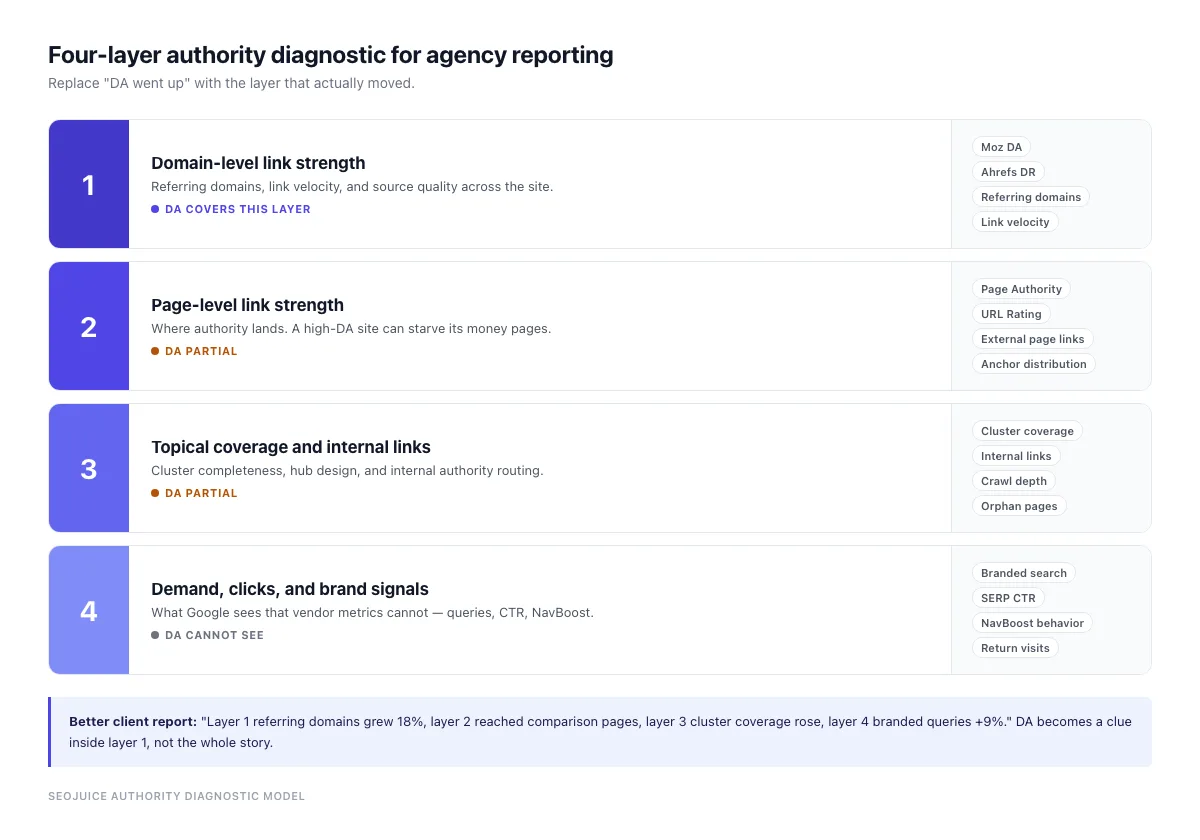
A better report line: “The site gained referring domains from relevant SaaS publications, improved internal links into comparison pages, and now sits within the authority range of page-one competitors for three target clusters.”
That sentence tells the client what changed, why it matters, and where the work connects to rankings.
Report authority in four layers
- Domain-level link strength.
- Page-level link strength.
- Topical coverage and internal links.
- Query demand, clicks, and brand signals.
DA mostly belongs to layer one. Sometimes layer one is the bottleneck. Often it is not.
This is where agencies can stop fighting clients about whether DA matters. Say yes, then put it in the right layer. The vanity number becomes a clue, not a boss.
When DA is the bottleneck
DA matters most when every serious competitor has stronger domains, similar content quality, and stronger topical coverage. In that case, links and brand distribution may be the constraint.
You will usually see the pattern across clusters, not one keyword. Your pages are relevant. They are indexed. They answer the query. They still sit below stronger domains with comparable pages. That is when authority acquisition deserves budget.
When DA is a distraction
DA is a distraction when pages are not indexed, titles miss intent, content overlaps, technical rendering fails, or internal links point everywhere except the money pages.
I have seen teams chase links while half their pages cannibalized each other. I have also been that team (ask me how I know). The DA conversation felt strategic because it avoided the uglier audit.
Before asking for more authority, make sure the site can receive it.
Final verdict: DA is a compass, not the terrain
Domain Authority is useful. It is also overpromoted. The honest position is that DA is a public proxy for a private, multi-signal ranking system — useful for comparison, dangerous as a target.
If you use DA to choose competitors, sanity-check link opportunities, and explain relative authority, it helps. If you use it as a ranking target, it will make your SEO worse.
The strongest teams do not ignore DA. They demote it. They treat it as one signal in an authority diagnosis that also includes page strength, topical fit, internal links, technical health, clicks, and brand demand.
FAQ
Is domain authority a Google ranking factor?
No. Moz Domain Authority is not a Google ranking factor. Google does not use Moz’s DA score. The 2024 leak suggests Google has its own domain-level siteAuthority feature, but that is not the same as Moz DA.
What is a good domain authority?
A good DA is one that puts you near the authority range of the sites ranking for your target topics. A DA 35 site may be strong in one niche and weak in another. Compare against SERP competitors, not the whole internet.
How long does it take to increase domain authority?
It depends on your starting point, link profile, niche, and the rest of the web. Lower scores move faster than higher scores because DA is logarithmic. Expect meaningful movement to take months, not days.
Should I buy links to increase DA?
Buying links just to raise DA is a bad incentive. Some paid placements may create visibility, but link schemes can create risk and usually do not fix page quality, internal authority flow, or query fit.
Why did my DA drop if my traffic stayed the same?
DA can drop because Moz’s index changed, competitors gained links, or the model recalculated the broader web. If traffic, rankings, and conversions are stable, do not treat a small DA drop as an emergency.
Want authority diagnostics instead of DA theater?
seojuice.com helps find page health issues and contextual internal linking opportunities so authority reaches the pages that need it. Use DA as the compass. Fix the terrain.
Read More
- Why Manual SEO Is Quietly Bleeding Your Agency Margin
- 15 Time-Saving SEO Tips for Freelancers
- 10 On-Site SEO Elements That Influence Rankings in 2026 (Priority Order)
- Internal Linking Statistics 2026: 35+ Data Points (Without the Magic Link Count)
- SEO Statistics 2026: What We Learned Crawling the Web
14 days free · cancel anytime