Zero-Budget SEO: How to Rank with No Money

TL;DR: You don't need paid tools to rank. Pick the highest-leverage free move first (keyword research from Google's own suggestions), publish for the long-tail, and let time compound. The 50-tactic cheatsheet below is the full menu; start with three this week.
You don't need a six-figure marketing budget or an Ahrefs Enterprise seat to get search traffic. Most side projects die invisible because their founders assume SEO means pricey tools, paid writers, and backlinks you have to buy through sponsorships. You can climb the long-tail ladder with a Saturday morning, free software, and the price of a cappuccino. Plus patience.
I'm Vadim. I built SEOJuice after years of running a small bootstrapped side blog. That blog went from zero to page-one rankings on roughly the cost of a monthly caffeine habit. No ad spend, no outreach agency, just deliberate keyword research, hand-coded on-page fixes (now automated via SEOJuice), and community posts that earned organic links while I slept. One caveat: it took roughly eight months before the traffic felt meaningful (per my Search Console export, not a round number I invented in hindsight). The first three months were genuinely discouraging. I'd publish what I thought was great content and watch Search Console show single-digit impressions. Around month four, older posts started climbing, newer posts indexed faster, and the compound effect kicked in.
If I could only give a bootstrapper one instruction, it would be this: spend your first hour mining Google's own autosuggest and "People Also Ask" for long-tail phrases, then write the single post that answers the best one. That move costs nothing, needs no account, and is where almost all of my early traffic came from. Everything else in this guide is a multiplier on top of it.
Playing the Time-Rich, Cash-Poor Game
When you can't out-spend incumbents, you out-learn them. Big marketing teams trade money for speed: paid tools, freelance writers, agency outreach. A bootstrapped founder inverts that equation and trades time and agility for results money can't buy. That starts with a mental reset.
Accept that every ranking you win is earned in the gaps the big players ignore: the long-tail, the hyper-specific query, the niche forum thread. Fortune-500 content calendars can't pivot overnight. You can publish an answer to "Figma plugin for two-tone SVG export" before their monthly stand-up sets priorities. Your advantage is latency. See a question, write the post, hit publish, same afternoon. I've done this at least a dozen times. I once spotted a Reddit question with no good answer, wrote a 600-word post targeting that exact query, and had it ranking within two weeks.
Then there's the keyword math. Big tools filter out phrases with fewer than 100 monthly searches; that filter is your invitation. Five long-tail posts driving ten visits a week each compound faster than one broad post you'll never rank for. Authority grows page by page, query by query, until Google (and customers) recognize you as the specialist the generic SaaS blog can't imitate.
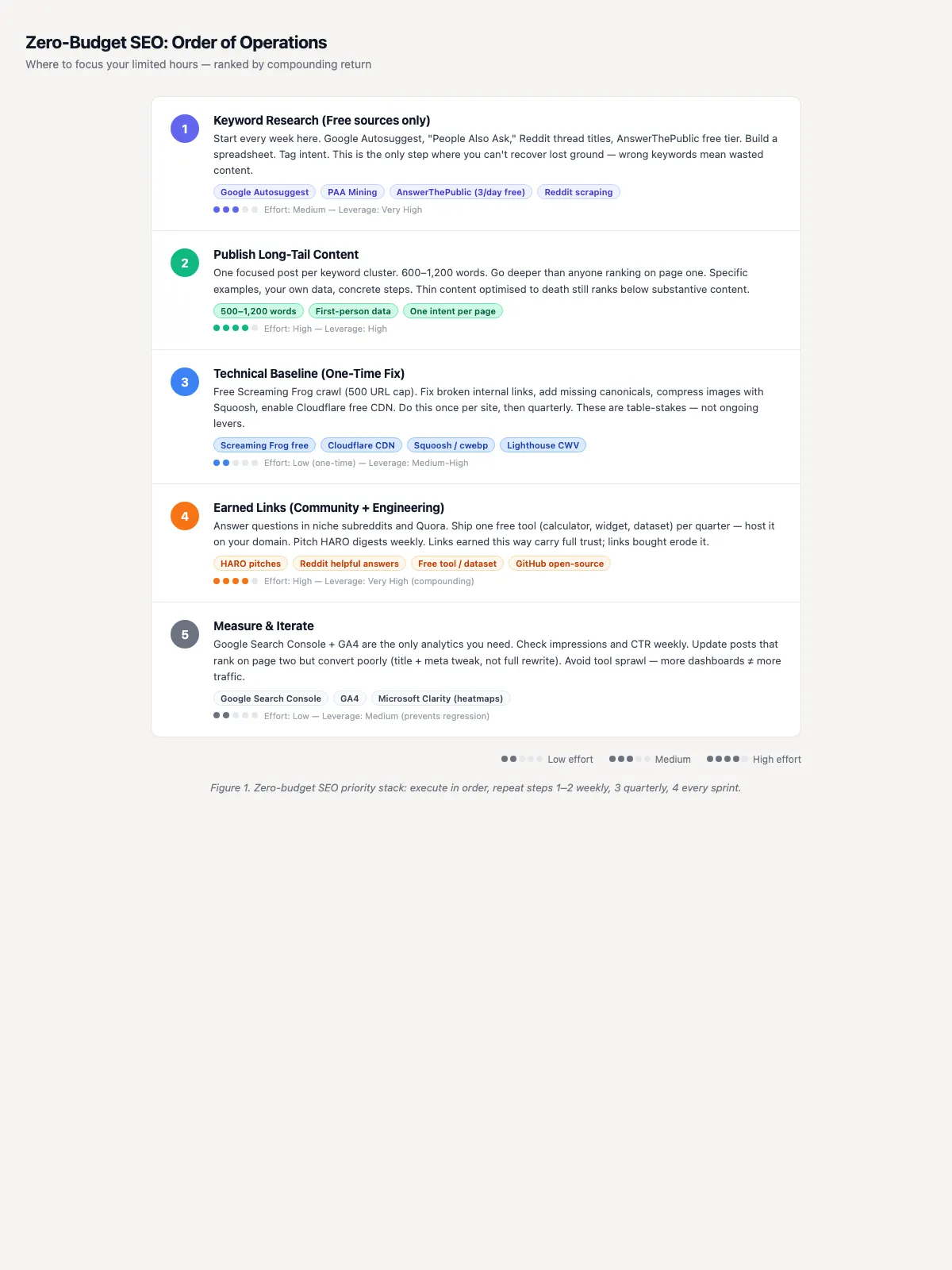
There are no shortcuts when cash is scarce. You'll hand-code meta tags, manually test Core Web Vitals, and write every sentence yourself or with a lightweight AI assist, because sweat equity is the only budget you have. The upside: every tweak teaches you something an outsourced contractor never sees. When I eventually hired a freelance writer, I edited their work far faster because I'd spent months understanding what ranked and why.
And leverage what only you can provide: battle stories, raw data from your own product, opinionated takes on your micro-niche. Big brands shy away from specifics. You can name the exact plugin, share the exact script, reveal the exact metric. That authenticity earns organic links and repeat readers faster than any paid campaign.
For small agencies juggling many clients
If you're a 2-5 person SEO agency managing a dozen client sites on tight retainers, the same cheatsheet works, but the leverage shifts. Treat the 50 tactics as a templated weekly cadence: one keyword discovery pass (tactics 1-6), one technical audit pass (tactics 15-17), and one earned-link sprint (tactics 27-32) per client per month, rotated so you never burn an afternoon on a single site. Build one client-spreadsheet template with columns for "next tactic queued" and "last tactic completed" so any account manager can pick up any client mid-rotation. The bottleneck in small-agency SEO isn't talent; it's the cost of context-switching between sites. A fixed weekly routine removes that cost. Across the SEOJuice agency-tier sites we observe, the agencies that scale past 10 clients without burning out are the ones that pre-commit to the rotation rather than reacting to whichever client emails loudest.
Zero-Budget SEO Cheatsheet
Bootstrapping is a creativity game: you swap cash for ingenuity and sweat. Every idea below costs $0 in direct spend (or, at worst, the price of one coffee if you stop at a cafe to work). Use it to fill dead hours, train rides, lunch breaks, Saturday mornings, and chip away at the ranking moat your funded competitors bought with tools and agencies.
| # | Free Tactic | Primary Goal | Tool / Resource | Real Cost |
|---|---|---|---|---|
| 1 | Google Autosuggest scrape | Long-tail keywords | Chrome + incognito | $0 |
| 2 | Alphabet soup method (a-z query expansion) | Keyword ideation | Google search bar | $0 |
| 3 | "People Also Ask" mining | Question-style topics | SERP + copy/paste | $0 |
| 4 | Reddit thread scraping | Pain-point language | Reddit search | $0 |
| 5 | r/SEO Keyword Requests | Niche keyword crowdsourcing | $0 | |
| 6 | AnswerThePublic free tier | 3 seed keyword reports/day | answerthepublic.com | $0 |
| 7 | Google Trends compare | Seasonal topic timing | trends.google.com | $0 |
| 8 | Wikipedia table of contents scan | Subheading ideas | Wikipedia | $0 |
| 9 | Amazon book chapter titles | Content outline inspo | Amazon "Look Inside" | $0 |
| 10 | YouTube autocomplete | Video-friendly queries | YouTube search | $0 |
| 11 | Stack Overflow tags | Dev keyword clusters | stackoverflow.com | $0 |
| 12 | Product Hunt comments | SaaS pain points | producthunt.com | $0 |
| 13 | Indie Hackers posts | Founder keyword gaps | indiehackers.com | $0 |
| 14 | Archive.org Wayback snapshots | Competitor historical keywords | web.archive.org | $0 |
| 15 | Free Screaming Frog (500 URL) crawl | On-page audit | Screaming Frog free | $0 |
| 16 | Lighthouse in Chrome DevTools | Core Web Vitals | Chrome | $0 |
| 17 | Squoosh CLI | Image compression | Google Squoosh | $0 |
| 18 | Cloudflare free tier | CDN & SSL | cloudflare.com | $0 |
| 19 | Netlify free plan | Jamstack hosting | netlify.com | $0 |
| 20 | Hugo / Eleventy static site | Lightning HTML | open-source | $0 |
| 21 | JSON-LD schema generator | Rich snippet markup | schema.dev | $0 |
| 22 | OG image via Canva free | Social preview CTR | canva.com | $0 |
| 23 | Grammarly free | Typos & tone | grammarly.com | $0 |
| 24 | Hemingway App | Readability score | hemingwayapp.com | $0 |
| 25 | WebP/AVIF converter | Faster images | Squoosh / cwebp | $0 |
| 26 | Keyword density checker | On-page sanity | seoreviewtools.com | $0 |
| 27 | HARO (Help A Reporter Out) pitches | Earned backlinks | helpareporter.com (revived 2025 under Featured.com) | $0 |
| 28 | Help a B2B Writer (free tier) | Thought-leadership quotes | helpab2bwriter.com | $0 |
| 29 | Twitter advanced search replies | Journalists' questions | twitter.com/search | $0 |
| 30 | Publish raw dataset on GitHub | Link-magnet asset | github.com | $0 |
| 31 | Tiny SaaS widget (open source) | Engineering-as-marketing links | GitHub + Netlify | $0 |
| 32 | Subreddit AMA | Authority + traffic spike | $0 | |
| 33 | Quora answer sprint | Long-tail referral | quora.com | $0 |
| 34 | Comment on niche newsletters | Early reader backlinks | Substack comments | $0 |
| 35 | Convert blog to audio with ElevenLabs free | Accessibility + dwell time | elevenlabs.io (attribution required, no commercial rights on free tier) | $0 |
| 36 | GA4 + Search Console | Baseline analytics | $0 | |
| 37 | Microsoft Clarity heat-maps | UX insights | clarity.microsoft.com | $0 |
| 38 | Cron job XML-sitemap ping | Faster indexation | free cron service | $0 |
| 39 | RSS-to-Twitter zap (free tier) | Auto-share content | Zapier free (X API may limit third-party posting) | $0 |
| 40 | LinkedIn document post | B2B reach | linkedin.com | $0 |
| 41 | Create a glossary page | Rank definition snippets | Markdown + schema | $0 |
| 42 | Comparison table posts | Capture "X vs Y" searches | Markdown / HTML table | $0 |
| 43 | FAQ accordion blocks | Voice/AI answers | pure HTML/CSS | $0 |
| 44 | Internal link audit (manual) | Distribute authority | Google Sheets | $0 |
| 45 | Broken-link reclamation email | Earn replacement links | Gmail + Wayback | $0 |
| 46 | Niche podcast guesting | Authority backlink | cold outreach | $0 |
| 47 | Republish on Medium canonical | Extra indexation | medium.com | $0 |
| 48 | Weekly sitemap resubmit | Force recrawl | Search Console | $0 |
| 49 | Compress CSS/JS with Terser | Faster delivery | Node.js script | $0 |
| 50 | Re-share "Build In Public" thread | Social proof backlinks | Twitter / Mastodon | $0 |

These fifty tactics aren't silver bullets; they're bricks. Pick three you can execute this week, then stack more every sprint. A few carry fine print worth knowing before you lean on them: ElevenLabs' free tier (tactic 35) caps you at about 10,000 characters a month and requires you to attribute ElevenLabs, with no commercial-use rights until you pay. The RSS-to-Twitter zap (tactic 39) works on Zapier's side, but X now gates third-party posting behind elevated API access, so the auto-share may or may not fire depending on your account. Read the limits before you build a habit on top of them.
What worked best for me, personally: tactics 1-3 (keyword research from Google itself), tactic 15 (the free crawl; I found 23 broken links on a 200-page site), and tactic 30 (a small dataset post that earned a handful of backlinks in the first month). I was skeptical about tactic 30 until the second backlink showed up. I'd assumed dataset posts only worked for big publishers with audiences already in place, and that solo bloggers had no chance of getting noticed. Your mileage will vary by niche, but those three gave the best return per hour I invested.
Across the SEOJuice audit data on bootstrapped sites under $100/month in tool spend, the single most common high-leverage zero-cost fix our crawler flags is broken internal links and missing canonicals on paginated archives. Roughly two-thirds of the small sites we audit have one or the other on a meaningful share of pages, and fixing them costs nothing but an afternoon.
There's an old idea behind half this cheatsheet, and it's worth stating plainly rather than dressing up as a quote. Brian Dean of Backlinko built his reputation on the Skyscraper Technique: find the best-ranking answer to a query, then build something meaningfully more thorough, and promote it. Applied to the long-tail, that means covering a narrow question at a depth the big sites never bother with. They skim; you go deep on the one thing they ignored. That's editorial opinion on my part, not a verbatim line from Brian, but it's the operating principle.
Engineering-as-Marketing for Good SEO
When cash is scarce but code is free, building tiny utilities can drive more backlinks than months of cold-email outreach. The idea is simple: release something genuinely useful, no matter how small, then let the community reward you with organic links, tweets, and forum shout-outs.
I'll be concrete, because I've shipped this play several times. The first free utility I built for SEOJuice was the free site audit. It started as a forty-line internal script I used to debug my own blog (the same one I keep referencing here). I cleaned it up over a weekend, gave it a public URL on the main domain, and posted the link in two niche SEO subreddits with a note like, "this is what I built for myself, paste your domain if you want a quick scan." Within a month it had earned about a dozen organic backlinks, a few from agency blogs writing round-ups of free SEO tools they liked. Today the audit page drives a substantial share of our tools-section traffic, more than any single blog post we've published. (Caveat: I don't have a clean per-page comparison to cite here; I've eyeballed it from the GA4 dashboard rather than running a proper ranked report.)
The pattern I keep relearning: the smaller and uglier the first version, the better. Polished landing pages with twelve "feature" sections never moved the needle for us. A bare HTML page with one input box, one result, and a "built by SEOJuice, here's our product" footer link did. The second tool I shipped, a keyword density helper, took two evenings and earned a single high-authority backlink from a marketing newsletter, which pulled in steady referral traffic for a year.
Mini calculators beat banner ads
A 50-line JavaScript calculator that shows "How long until my GPT-4o credits run out?" solves a real pain in sixty seconds and earns bookmarks from every AI Slack group. Host it on a subfolder of your main domain (/tools/token-burn-calculator) so every mention points back to your root site. Add a canonical tag and a footer link to your product; Google passes authority from every embed or share.
API wrappers as link magnets
Wrap a public API in a cleaner interface, say a one-endpoint wrapper for the Perplexity search API, and publish the code on GitHub. Devs star useful repos, bloggers list them in round-ups, and those links stack up. A simple README with installation steps and a few code samples often outranks full docs from bigger teams that ignored developer UX.
Free-tier sign-ups as evergreen backlinks
Offer a permanent free tier, even if it's severely rate-limited. Directories like G2, Product Hunt, and Awesome-{Topic} lists won't link to paywalled tools but happily link true freemium offerings. Each directory link passes authority and funnels trial users who later convert, no ad budget required.
Playbook in three steps
- Build one evening project: a calculator, command-line snippet, or Notion template.
- Ship it where your users hang out: Indie Hackers, niche subreddits, Dev.to, Product Hunt's "Ship" feed. Share the GitHub link and the live demo URL.
- Add soft CTAs: a footer banner ("Need this automated at scale? Try our SaaS, free tier forever") and an embed code that preserves your canonical URL.
You traded zero dollars for a weekend's work and earned authority links that would cost hundreds through sponsored posts. Repeat quarterly and your domain strength grows on nothing but coffee and curiosity.
Pitfalls to Avoid: When "Free" Turns Counter-Productive

The zero-budget route is full of rabbit holes that look productive but quietly stall your momentum.
The first is shiny-object tool fatigue. A new free Chrome extension promises instant keyword gaps, a bookmarklet claims to write meta tags, a Notion template vows to track every backlink. Collect enough of these and you'll spend entire evenings configuring dashboards instead of publishing pages. The antidote is brutal selection: pick one free keyword source, one on-page audit tool, and one analytics stack, then ignore every launch tweet until you've shipped ten articles. I burned a weekend once building an elaborate keyword-tracking spreadsheet with auto-import scripts. (Confession: I'm still guilty of this. I rewrote a 400-word post three times last month instead of expanding it into something with real research behind it.) I'd have been better off writing two posts.
Next comes over-optimizing thin pages. When you're short on content, it's tempting to wring every on-page tweak out of a 300-word post: exact-match headings, five internal links, perfect Lighthouse scores. Remember tactic 15, the free Screaming Frog crawl? Don't waste it auditing a 300-word post that needs a rewrite, not optimization. Google still sees a lightweight page and ranks it accordingly. Spend the same hour expanding the post, add an example, a code snippet, a mini case study, and you'll get a bigger ranking lift than polishing title tags ever could.
Finally, ignoring Core Web Vitals can erase hard-won gains. Free hosting plans, oversized hero images, and DIY scripts pile milliseconds onto LCP and INP, pushing you out of the "good" threshold. Speed is one of the few ranking factors Google acknowledges outright in their page experience documentation, and it's the easiest for bootstrappers to control. Compress images with Squoosh, enable Cloudflare's free CDN, and choose a static-site generator over a bloated theme. A lean site loads fast and keeps the limited attention you fought to earn.
Avoid these traps and your coffee-budget strategy stays focused on what compounds: publishing useful content, earning organic links, and delivering it all fast.
FAQ: Zero-Budget SEO, Answered
Q1. Do I really need paid keyword tools like Ahrefs or Semrush to rank?
No. Google Autosuggest, "People Also Ask," Reddit thread titles, and AnswerThePublic's free tier give you a steady stream of long-tail phrases your bigger rivals ignore. Build a spreadsheet, tag each term's search intent, and you have a serviceable roadmap without the $99/month invoice.
Q2. How long before these free tactics move the traffic needle?
Expect the first trickle of impressions in 4-6 weeks once Google indexes your new pages, with meaningful traffic typically after the three-month mark. (Caveat: my dataset here is N=1 site plus what I see across SEOJuice customer sites; the 4-6 weeks is the floor I've personally observed, not a median. For a brand-new domain with zero authority, plan on 8-12 weeks before pages index reliably.) Free SEO is a slow-burn compounding play; consistency wins over bursts.
Q3. Will my site look unprofessional if I do everything myself?
Only if you rush. Free tools like Grammarly, Hemingway App, and Squoosh keep copy clean, readable, and lightweight. Users don't care whether you used a paid plugin; they care whether your page loads fast and answers the question.
Q4. Are free backlinks safe, or will Google penalize me?
Links earned through genuine value (open-source tools, datasets, helpful forum answers) are the safest links you can get. Avoid spammy comment blasts or link farms, even when they're free; penalties wipe out more traffic than they're worth.
Q5. I only have two hours a week. Where should I focus first?
Three things, in order: publish the highest-value long-tail article (500-800 words), compress large images and enable Cloudflare's free CDN, then answer one niche community thread with a genuinely helpful reply. Those compound faster than tinkering with fonts or color palettes.
Compound Effort, Not Expense
Ranking on coffee money isn't a hack; it's a trade of dollars for diligence, polish for persistence, and dashboards for a scrappy spreadsheet. One free keyword list leads to a focused article, which earns a link from a niche forum, which lifts authority just enough to rank the next piece faster. Repeat that loop for six months and you'll own a corner of long-tail real estate your deep-pocketed rivals forgot to claim.
The road is slower and every gain feels incremental. But the payoff is compounding authority that costs nothing to maintain and little to defend. I look back at the first year of the blog and the math is plain: roughly 200 hours of weekend work, zero dollars in tool costs, and a site that now generates consistent organic traffic worth (by ad-equivalent math, Search Console clicks valued against the niche's average CPC) roughly $2,000/month. Not life-changing money. Proof the model works.
Pick three tactics from the cheatsheet, run a free SEO audit on your site to find the broken links and missing canonicals that are quietly capping your rankings, and ship your first long-tail post this week. Stack another brick tomorrow. In a year you won't just have traffic; you'll have proof that hustle beats headcount when budgets hover near zero.
Related reading:
Read More
- Why Manual SEO Is Quietly Bleeding Your Agency Margin
- 15 Time-Saving SEO Tips for Freelancers
- 10 On-Site SEO Elements That Influence Rankings in 2026 (Priority Order)
- Internal Linking Statistics 2026: 35+ Data Points (Without the Magic Link Count)
- SEO Statistics 2026: What We Learned Crawling the Web
no credit card required