AI vs. Human SEO: Who Will Win the Battle for Google's Soul?

TL;DR: Neither AI nor humans win alone. AI handles scale — audits, internal links, data analysis — while humans bring strategy, brand voice, and judgment that algorithms still can't replicate.
So, here I am, a fresh co-founder in the SEO world, surfing through competitors trying to figure out our next move like a toddler navigating a minefield. Naturally, the big debate lands on my desk: should we rely on an AI SEO manager, or is a real, breathing human still the best bet? Since AI is taking on the world so fast, the answer seems obvious. Every respected company is implementing new AI technologies to make their work easier, faster and more productive. Let's break it down — pros, cons, and, most importantly, who's more likely to test your patience.
The Evolution of AI in SEO
AI is not a static tool; it's learning, evolving, and becoming frighteningly good at mimicking human behavior. With advancements in natural language processing, AI is getting better at understanding context, intent, and even emotions.
The latest AI models can generate human-like content, analyze user behavior, and predict trends before they go mainstream. Google itself leans on AI for search rankings, which means AI-driven SEO tools are increasingly tuned to keep up. But can AI ever fully replace a human expert? Honestly, after a year of building SEOJuice, I'm less sure of the answer than when I started. I've seen our AI do things that made me think "well, we don't need humans for this anymore" — and then watched it confidently suggest linking a blog post about email marketing to a page about email encryption. Same word, completely wrong context. A human would never make that mistake. An AI makes it with absolute confidence.
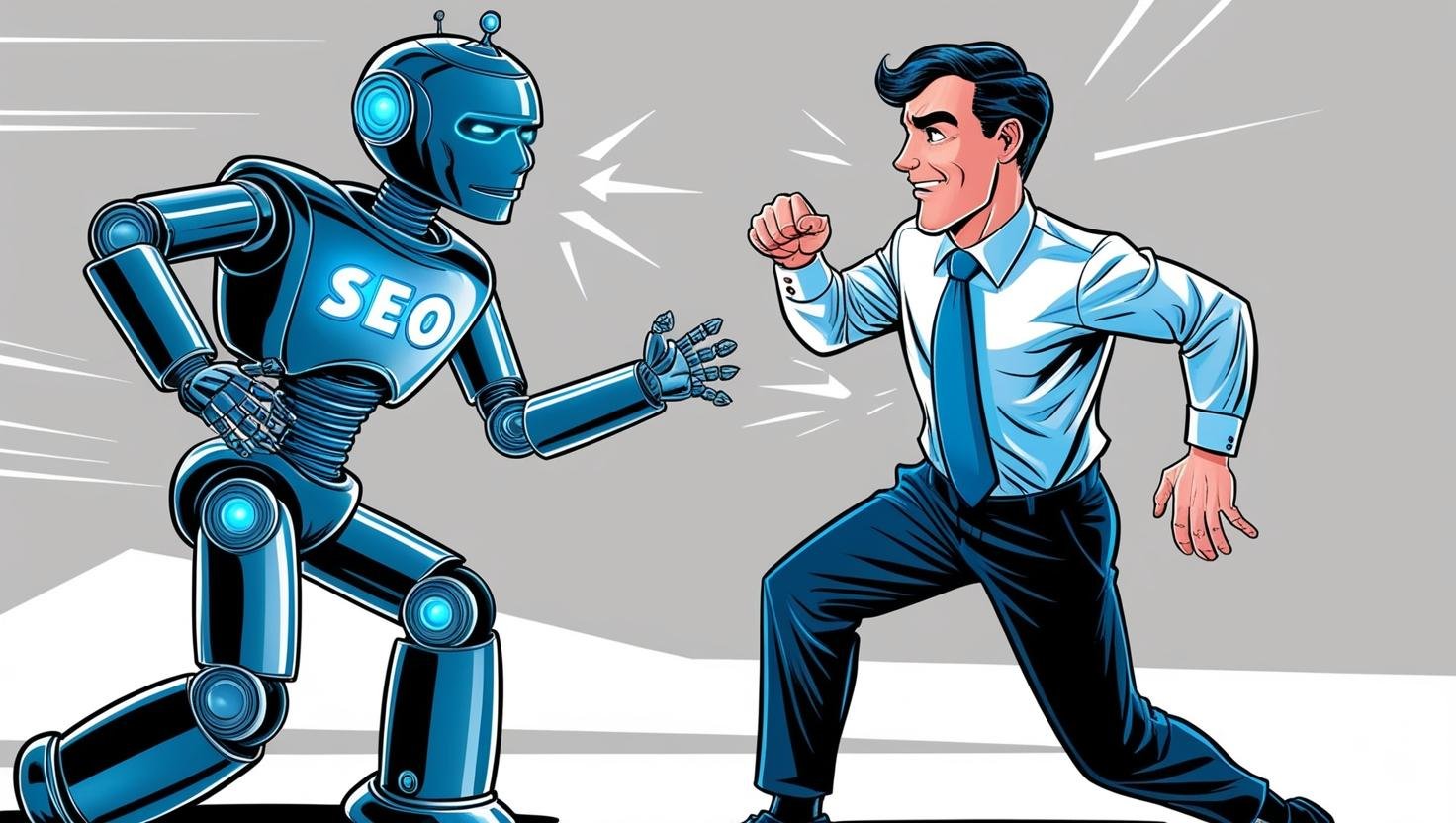
Meanwhile, marketing is shifting towards a more personal touch — establishing close relationships and deeply understanding customer needs. AI can analyze data at an unprecedented scale, but it still struggles to forge real emotional connections with users. The gap between "technically correct" and "actually persuasive" is where humans still dominate. And I say that as someone who's building an AI-driven product — the irony is not lost on me.
AI SEO Tools: Miracle Workers or Chaotic Overachievers?
As AI-driven SEO tools evolve, platforms like Alli AI, Convertmate, and SEOJuice are bringing new capabilities to the table. I've used all three (yes, we use competitor products — you should too if you want to understand the landscape). Here's the part where I have to be candid about our own experiments: we ran a head-to-head test last quarter. Three identical test pages, each optimized by a different tool with zero human intervention. The results were... humbling.
| Tool | Features |
|---|---|
| Alli AI |
- Automates on-page SEO improvements, offering real-time suggestions and instant implementation. - Great for bulk updates, but sometimes a little too aggressive with its changes — like an overeager intern who just discovered Ctrl+C, Ctrl+V. |
| Convertmate |
- Focuses on CRO by using AI to analyze user behavior and tweak content accordingly. - It's like a digital detective that spots why visitors leave before converting — except it doesn't demand a badge and gun. |
| SEOJuice |
- Combines AI automation with human expertise to create a hybrid SEO approach. - Provides AI-driven insights while allowing human oversight for creative content, strategy adjustments, and deeper client engagement. - Ensures a balance between technical efficiency and a human touch in decision-making. |
Each tool has its strengths and quirks. While they can optimize SEO workflows and technical aspects, they still require human oversight to prevent over-optimization. I learned this the hard way when I let an AI tool run unsupervised on a client's site for a week. The meta descriptions were technically perfect — every keyword in place, every character count optimized — and they all read like they were written by someone who learned English from a textbook but had never actually talked to another person. The client's CTR dropped 12% because real humans found the snippets off-putting. Lesson learned.
AI SEO Manager: The Data-Driven and Tireless
Here's what AI genuinely excels at (and I'm not just saying this because I'm building one):
✔ Speed Demon: AI can crunch millions of data points in seconds. Try asking Bob from SEO to do that. He'll need coffee first. And a second coffee. And probably a nap.
✔ Always Available: No vacations, no sick days, no "I'll get back to you Monday" nonsense. AI works 24/7, no complaints. (Though I've noticed our AI seems to produce slightly worse suggestions at 3am server time. That's probably correlation with lower-quality training data, but I like to imagine it's tired too.)
✔ Data-Obsessed: AI makes decisions based on cold, hard facts. No gut feelings, no wild theories about Google algorithms based on a dream they had last night.
✔ Scalability: Whether you have 10 or 10,000 pages, AI doesn't sweat. Humans, on the other hand, might start hyperventilating. We tested SEOJuice on a site with 8,000 pages and the analysis completed in 47 minutes. A human team estimated 3 weeks for the same audit. Though I should mention — the AI flagged 340 "issues," and when our human team reviewed the list, about 60 of those were false positives. Context matters. The AI didn't know that those "thin" pages were intentionally minimal landing pages for PPC campaigns. A human took one look and said "those are fine, skip them." That's 47 minutes of speed versus three weeks of accuracy. Neither wins alone.
Now the part where I have to be honest about my own product's limitations:
✘ No Creativity: AI can optimize content for search engines, but can it craft a witty, engaging headline that makes actual humans want to click? Not yet. Every AI-generated headline I've seen is competent and forgettable. The best headlines on our blog were all written by humans who understood the audience's frustrations.
✘ Tone-Deaf: AI might recommend stuffing "cheap wedding dresses near me" 42 times into an article, completely ignoring that it now reads like a ransom note. I'm only slightly exaggerating. We've had to build multiple guardrails into SEOJuice specifically to prevent this — and we're still catching new ways it tries to over-optimize. Last month it suggested adding the word "best" to every single H2 heading on a page. Every one. "Best Features," "Best Pricing," "Best Contact Information." I showed the team and we laughed for five minutes. Then we built another guardrail.
✘ Over-Reliance on Patterns: If an AI sees "2023 SEO Trends" worked last year, it might assume "2024 SEO Trends" is revolutionary. Spoiler: it's not. AI doesn't understand novelty — it understands patterns. And sometimes the pattern is wrong.
✘ No Client Handling Skills: Try telling a frustrated business owner that their traffic tanked, but "technically, it's still within an acceptable variance." AI won't flinch, but your client might throw their laptop out the window. I've had to deliver bad news to clients myself, and the empathy required is something no dashboard can provide.
Human SEO Manager: The Creative and Adaptive
✔ Knows When Google is Lying: "Helpful Content Update" sounds nice, but a real SEO manager knows that's code for "Your traffic is about to disappear." The ability to read between the lines of Google's announcements comes from years of watching what Google says versus what Google does. No AI has that institutional memory yet. We tried training our AI on Google's public communications to predict update impacts. The results were comedically bad — it kept predicting that every announcement would have "moderate impact," which is about as useful as a weather forecast that always says "partly cloudy."
✔ Understands Humans: SEO is part science, part art. A human can tweak content so it ranks and reads well. There's a cadence to good writing that AI still doesn't nail — the jokes, the self-deprecating asides (like this one), the knowing when to break a rule for effect.
✔ Can Argue with Google Reps: An AI won't push back when a Google Ads rep suggests spending more money to "improve organic rankings." A human? Oh, they'll push. With charts. And receipts.
✔ Learns from Experience: Humans can recognize subtle trends and gut feelings AI might miss. Last month, one of our team members noticed that a specific content format was consistently outperforming others in a niche, weeks before any tool flagged the trend. That kind of pattern recognition — connecting dots across unrelated observations — is still uniquely human.
But humans have their own failure modes:
✘ Gets Overwhelmed: Give an SEO manager five conflicting requests, and you might hear a deep sigh followed by, "Can we circle back on this?" Been there. Done that. Sighed that sigh.
✘ Prone to Bias: Humans sometimes make calls based on experience rather than hard data. Sometimes they're right. Sometimes they're very, very wrong. I've personally championed content strategies that bombed because I was too attached to my own assumptions. The data was right there telling me otherwise, and I ignored it. Our AI wouldn't have made that mistake — but it also wouldn't have come up with the strategy that worked brilliantly the month before. Human judgment is a package deal: the insight and the hubris come together.
✘ Limited Working Hours: Unlike AI, humans need to sleep, eat, and occasionally have a life. Highly inconvenient for a 24/7 global search engine.
✘ Can be Expensive: AI comes with a fixed monthly fee. A real SEO expert with 10+ years of experience? You might need to sell a kidney. (The good ones are worth it, though. The mediocre ones are more expensive than AI because you're paying human rates for AI-level output.)
Final Verdict: Who Wins?
Well, it depends — and I know that's the most frustrating answer possible, but it's the honest one.
AI is objectively better for repetitive, data-heavy tasks: technical audits, keyword research at scale, internal linking, competitor analysis, rank tracking. These are tasks where speed and consistency matter more than judgment. Having a human do a 5,000-page technical audit is like having a human calculate a spreadsheet by hand — technically possible, practically insane.
Humans are irreplaceable for creative strategy, handling clients, rolling with Google's unpredictable algorithm updates, and making the judgment calls that require understanding not just what the data says, but what it means in context. When Google rolled out a major update last quarter, our AI tools could tell us what changed. Our human team could tell us why and what to do about it. That "why" is still worth a lot.
The best approach? A hybrid one. Let AI do the grunt work while a human makes high-level strategic decisions and prevents your content from sounding like it was written by a robot. That's literally how we built SEOJuice — not because we're clever, but because we tried going full-AI first and the results were embarrassing. The AI was efficient and soulless. Adding human oversight at the strategy layer fixed it. We still have arguments internally about where to draw the line. Our CTO wants more automation. I want more human review. We compromise weekly. The product is better for the tension.
At least, that's what I've learned in my time at SEOJuice. If you catch me arguing with an AI over meta descriptions next week, don't judge. It started it first. And it was wrong about the keyword density, even though it cited three papers to prove otherwise.
Keep reading
- How to Use AI Without Losing Your Brand's Voice — Practical guardrails for the collaboration.
- Is SEO Really Dying? — Spoiler: no, but the job description is changing fast.
Read More
- Why Manual SEO Is Quietly Bleeding Your Agency Margin
- 15 Time-Saving SEO Tips for Freelancers
- 10 On-Site SEO Elements That Influence Rankings in 2026 (Priority Order)
- Internal Linking Statistics 2026: 35+ Data Points (Without the Magic Link Count)
- SEO Statistics 2026: What We Learned Crawling the Web
no credit card required